

A discovery of novel catalyst for catalytic wastewater purification
Researchers from Laboratory for Inorganic Chemistry and Technology (L09) Nataša Novak Tušar, Darja Maučec, Matjaž Mazaj, Mojca Rangus and Venčeslav Kaučič in collaboration with Albin Pintar, Magda Cotman (Laboratory for Environmental Sciences and Engeenering L05) and Iztok Arčon (University Nova Gorica) designed a novel and environmentally friendly, cost-effective as well as highly efficient catalyst for catalytic wastewater purification. The discovery was published in one of the prestigious journals covering the area of materials science - Advanced Functional Materials (impact factor 8.49).
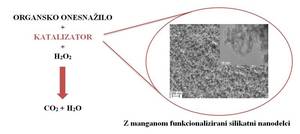
Wet hydrogen peroxide catalytic oxidation (WHPCO) is one of the most promising industrially applicable advanced oxidation processes (AOPs) for the decomposition of organic pollutants in water. Researchers demonstrated for the first time that manganese functionalized silicate nanoparticles act as a superior catalyst in WHPCO, since they can completely decompose and convert to carbon dioxide 80 % of a test organic compound in 30 minutes at neutral pH and room temperature. By performing structural characterization of the material using X-ray absorption spectroscopic techniques and catalytic tests, it was also proven that the superior activity of the catalyst can be attributed uniquely to the manganese incorporated into silicate framework of nanoparticles, and not to manganese in the form of manganese oxides (Mn3O4, Mn2O3). The presented material thus introduces a new family of catalysts, which possess superior efficiency for the decomposition of organic pollutants dissolved in water.
The article is available here.