

A new sustainable catalytic process for biobased adipic acid
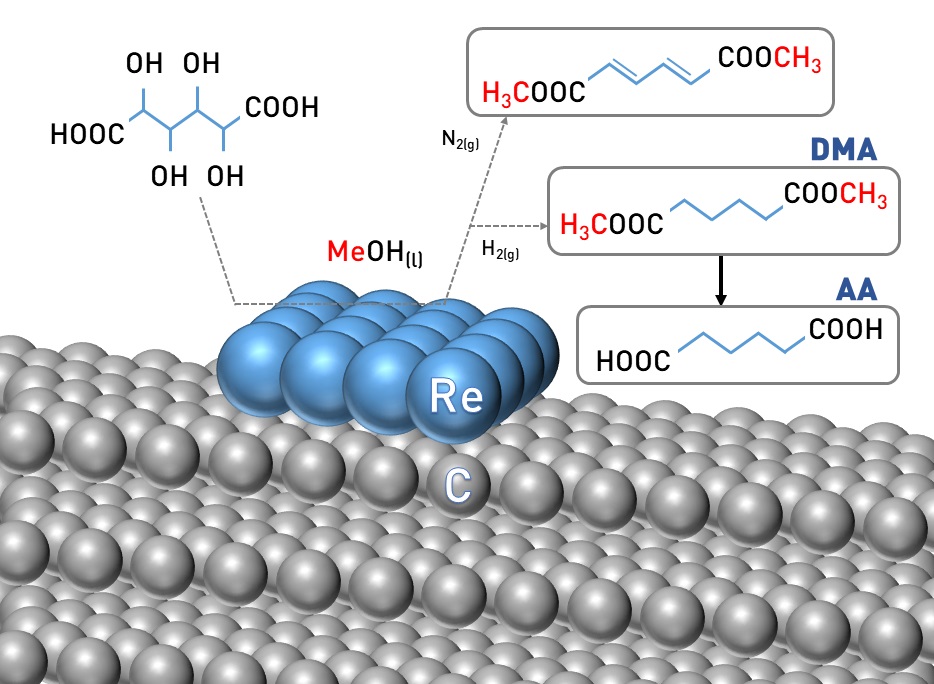
Adipic acid is one of the most important dicarboxylic acids in the polymer industry, which is unfortunately still produced in a highly exothermic oxidation process with NOx as a by-product. In the past, many studies have sought a new, more sustainable (chemo- or biocatalytic) process.
The researchers of the Department of Catalysis and Chemical Reaction Engineering (D13) under the supervision of Ass. Prof. Dr. Blaž Likozar, were the first to successfully develop an environmentally friendly process for producing adipic acid and its esters on a solid Re/C catalyst. It employs a selective dehydroxylation of bio-based aldaric acids, which themselves are the products of C6 sugars oxidation.
In this study, the process was developed and optimised, as well as the reaction mechanism was elucidated and a comprehensive characterization of the Re/C catalyst was carried out. Methanol was used as a solvent, playing a dual role in the process. Besides protecting the terminal carboxyl groups through esterification against lactone formation, it also acts as a hydrogen donor, which is formed at an elevated reaction temperature (> 150 °C) on the catalyst. H2 further saturates the double bonds formed during the removal of the hydroxyl (–OH) groups. At a lower reaction temperature (< 150 °C), no hydrogen is formed and the double bonds remain unsaturated, which with high selectivity leads to another industrially important monomer, muconic acid (ester). As a volatile solvent, methanol can be easily removed from the reaction mixture and reused.
In addition, the solid catalyst Re/C can also be easily filtered away and reused for further reaction cycles. No highly toxic or environmentally problematic chemicals are used in the process.
A comprehensive characterization of the catalyst was performed to understand the reaction mechanism on the catalytic surface. It was revealed that the size (larger are more active; > 1 nm) and oxidation state of the active metal plays a decisive role; the lower the oxidation number, the higher the activity of the catalyst. An important part of the study are also DFT calculations, which show the detailed reaction mechanism.
Last year (2019) the patent application for this new innovative process was filed and the results were recently published in Angewandte Chemie journal.
The article can be found under the following link: doi.org/10.1002/ange.202010035.
For further information please contact: brigita.hocevar[at]ki.si