

A novel combined characterization study of anode materials for Na-ion batteries
[Translate to English:]
Sodium-ion batteries are a promising alternative to widely used lithium-ion ones, because they show high energy density, improved safety and lower environmental impact. For this kind of devices, the choice of anode material is crucial, since it has an impact on the battery’s performance and stability, as well as on the formation of the so-called solid electrolyte interface. In the latest years hard carbons (i.e. non-graphitizable carbons), emerged as leading candidates for anode material in sodium-ion battery.
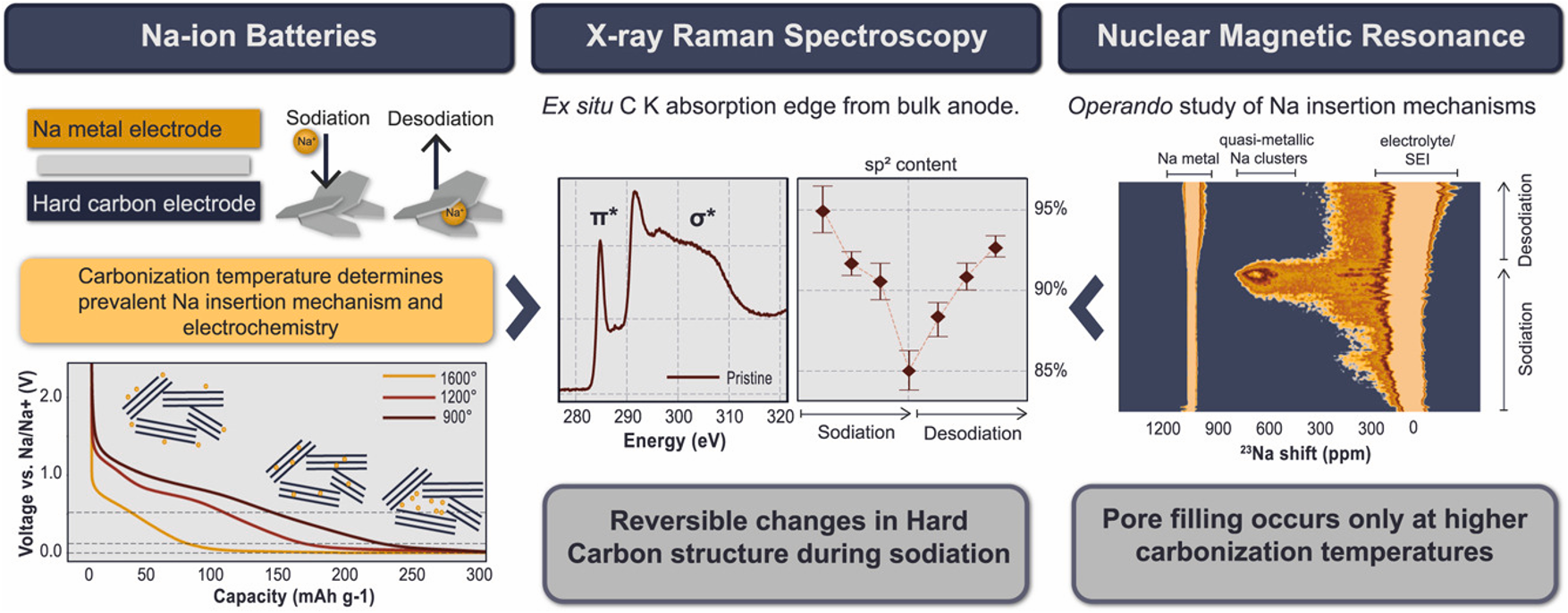
This study explores the structural changes of hard carbon (HC) negative electrodes in sodium-ion batteries induced by insertion of Na ions during sodiation. X-ray Raman spectroscopy (XRS) was used to record both C and Na K-edge absorption spectra from bulk HC anodes carbonized at different temperatures and at several points during sodiation and desodiation. Comparing the π*/σ* regions in the C K-edge spectra sp2/sp3 hybridization ratio of material was determined. Higher carbonization temperatures led to increased order in graphitic structure and shorter C-C bond lengths. Sodiation caused a decrease in graphitic layer order due to inserted Na ions. Complementary operando solid state nuclear magnetic resonance (ssNMR) studies confirmed the structural changes, while showing pore filling mechanism, primarily at higher carbonization temperatures. XRS analysis of Na K-edge spectra revealed systematic variations in the solid electrolyte interface (SEI) composition during cycling, in agreement with X-ray photoelectron spectroscopy (XPS) and ex situ NMR measurements.
Hopefully a better understanding of the influence of different carbonization temperatures and insertion of Na ions during sodiation on the structural changes of hard carbon negative electrodes will help to design more efficient, stable and long-lasting sodium-ion batteries.
The authors of this research are Ava Rajh, Klemen Bučar, and Matjaž Kavčič from the Jožef Stefan Institute, Matej Gabrijelčič, Blaž Tratnik, Robert Dominko, and Alen Vižintin from National Institute of Chemistry, Iztok Arčon from the University of Nova Gorica, and Marko Petrič from University of Zagreb, Faculty of Geotechnical Engineering, Croatia.
The work is published in Carbon.
Link: https://doi.org/10.1016/j.carbon.2024.119398
Cover graphics: Combined X-ray Raman and Nuclear Magnetic Resonance Spectroscopy study of Na-ion batteries.
Contact for further information: matej.gabrijelcic(at)ki.si and