Adenine-dependent G-quadruplex structural switch
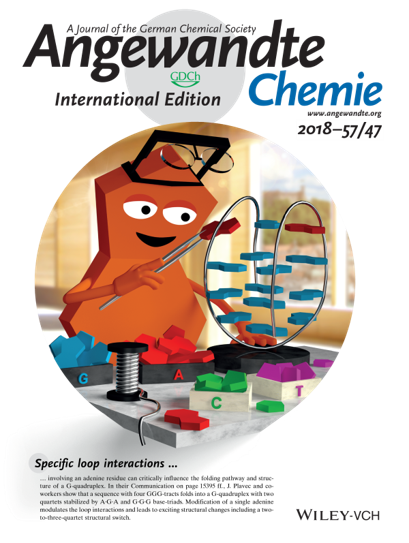
[Translate to English:] Članek si je prislužil notranjo naslovnico v reviji Angew. Chem. Int. Ed. 2018 – 57/47.
A G-rich sequence has been found in the regulatory region of the RANKL gene, whose excessive activity leads to unbalanced bone remodeling and can influence the incidence of osteoporosis. Molecular mechanisms of regulation of RANKL gene expression are not fully explained yet. Our structural study, to the best of our knowledge, is the first to suggest that expression of the RANKL gene may be regulated by putative folding of its G-rich region into unusual DNA structures, such as G-quadruplexes.
A 20 nucleotides long G-rich sequence with three GGG-tracts, 5' – GGGTAGGGAGCGGGAGAGGG - 3' (RAN4), folds into two-quartet G-quadruplex stabilized by A5•G3•A17 and G20•G8•G12 base-triads. Detailed analysis of high-resolution NMR structure of RAN4 (PDB id 6GZN) together with G/A-to-T modifications of residues from both base-triads uncovered the critical role of a single loop adenine A5 for the formation of distinct two-quartet and not three-quartet topology that would be expected based on the sequence alone. Comparison of RAN4 and RAN4A5T topologies relevels significant structural changes induced by A5-to-T5 modification including a switch from two- to three-quartet G-quadruplex.
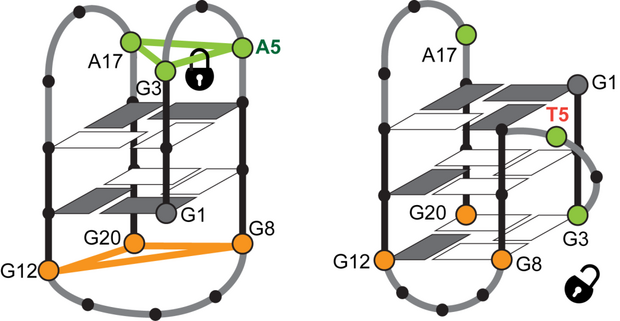
Switch between two-quartet (left, RAN4) and three-quartet (right, RAN4A5T) G-quadruplex depends on interactions of adenine A5 from A•G•A base-triad, where it forms hydrogen bonds with G3.
Our results indicate that specific loop interactions involving an adenine residue can critically influence the structure of a G‐quadruplex and provide insights into the complexity of intricate interactions that influence the folding process of G-rich DNA sequences. Moreover, understanding the impact of loop residues on the overall stability and formation of G-quadruplexes advances our ability to predict structures adopted by G-rich sequences and may also facilitate structure-based drug design. Results of the presented study, which was fully implemented on Slovenian NMR Centre on National Institute of Chemistry, were published in an article with title 'Adenine-driven structural switch from two- to three-quartet DNA G-quadruplex' in Angewandte Chemie International Edition. The article was highlighted as Hot paper and exposed on inside cover.
Link to article:
https://onlinelibrary.wiley.com/doi/pdf/10.1002/anie.201809328