

Analysis of C formation and removal in a catalytic reaction
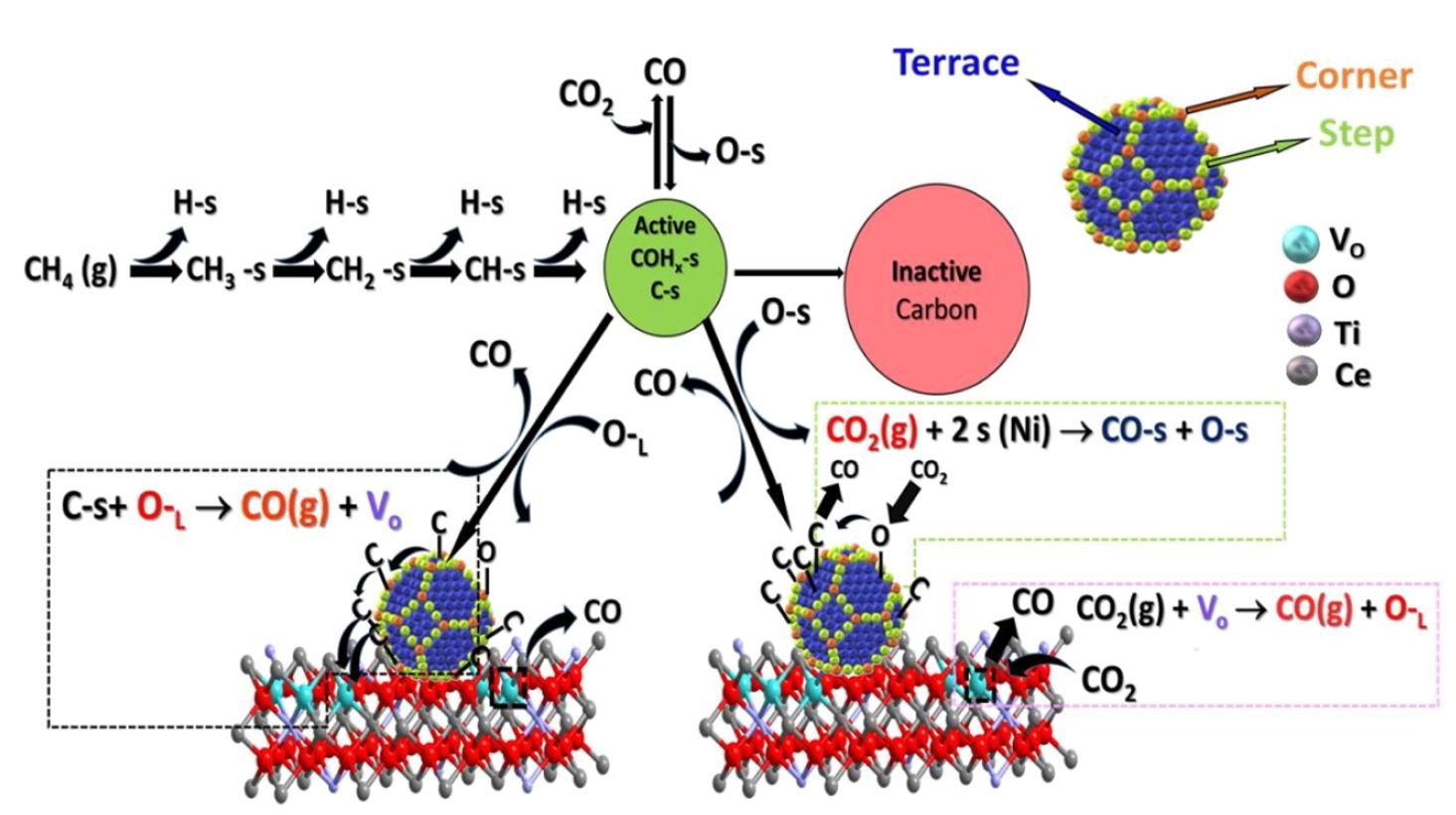
Methane and CO2 conversion to syngas (H2 and CO) is a promising catalytic pathway for large scale CO2 utilization with parallel CH4 valorization. However, over highly active nickel catalysts, fast carbon accumulation can obstruct long-term activity and represents a hurdle yet to be overcome. This research investigates the sources and reaction pathways of carbon formation as well as its removal using kinetic and isotopic analyses, with the aim of improving understanding and guiding synthesis towards carbon resistant materials.
Various correlations have been derived between CeTiO2 particle size and (i) the initial kinetic rates of CH4 dissociation and CO2 disproportionation reactions along with their respective amounts of carbon accumulation, (ii) the rate of carbon removal by lattice oxygen of support (redox pathway) compared to that by oxygen formed via the CO2 activation route during DRM (direct pathway). The rate of oxidation via redox pathway was higher compared to the one through direct pathwy, independent of CeTiO2 size. CH4 dissociation is the exclusive route of inactive carbon formation during DRM independent of CeTiO2 size.
Manuscript: Constantinos M. Damaskinos, Janez Zavašnik, Petar Djinović and Angelos M. Efstathiou: Dry reforming of methane over Ce0.8Ti0.2O2-δ/Ce0.8Ti0.2O2-δ: The effect of Ce0.8Ti0.2O2-δ particle size on the carbon pathways studied by transient and isotopic techniques, Appl. Catal. B: Environmental 296 (2021) 120321.
Online link: https://doi.org/10.1016/j.apcatb.2021.120321
Contact: petar.djinovic(at)ki.si