BioSPRINT for improvement of operations in bio-refineries
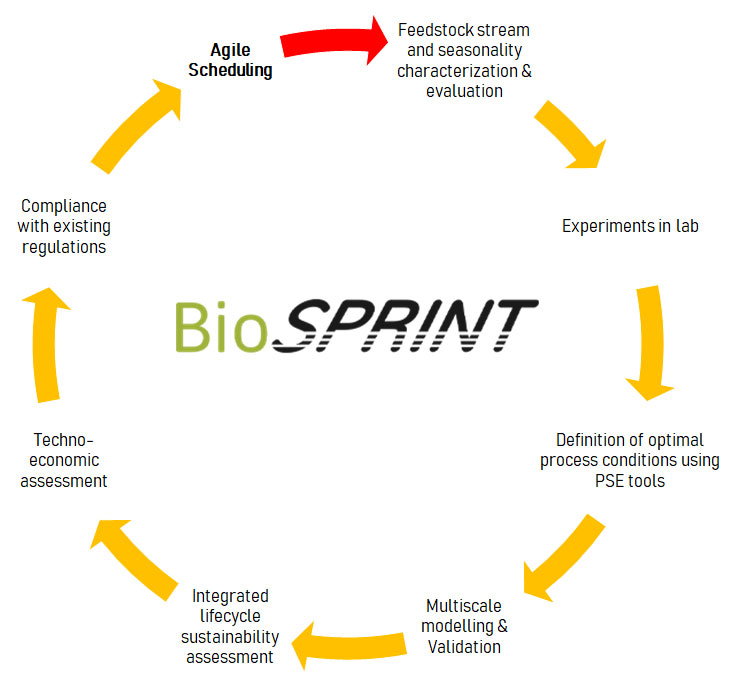
National Institute of Chemistry is participating in a consortium of the EU-funded international BioSPRINT project with which we strive to strengthen processing methods that fully exploit the feedstock potential of ligno-cellulosic biomass. The project aims to obtain furan-based bio-renewable resins for new polymer applications.
Ligno-cellulose is a very widespread type of biomass and has great potential for the development of high value-added chains, as it is one of the untapped renewable resources. If we want to double the current use of this biomass while maintaining it as a sustainable source, it is necessary to significantly improve the efficiency of its use in bio-refineries. A bio-refinery is a technological plant that includes processes for converting biomass and equipment for producing fuels, energy and chemicals based on bio-based feedstock. In the bio-economy concept, this leads to by-products which are the input feedstock for the production of new products and energy. Current processes for using and processing lingo-cellulosic biomass produce relatively high concentrations of impurities and waste, which reduces the overall efficiency of the bio-refinery and leads to poor product quality, while increasing complexity and production costs.
BioSPRINT applies process intensification in the context of bio-refining operations, so as to improve the efficiency of the purification and conversion of sugars from the hemicelluloses fraction of lingo-cellulosic biomass and to enable their transformation into new bio-based resins for substituting fossil based polymers in a range of applications. In this way, we want to reduce operating costs, feedstock and energy resources, greenhouse gas emissions and higher yields, from bio-refineries, while increasing operation safety, by concentrating on technologies which can intensify processing methods and create an integrated bio-refinery concept We will focus on a chemical engineering approach to development, augmentation and profitability, taking into account the actual raw materials available in the plants.
The BioSPRINT consortium is coordinated by DECHEMA. The implementation of the four-year project started on 1 June 2020.
Consortium: DECHEMA (Germany), AEP POLYMERS SRL (Italy), DYNAMIC & SECURITY COMPUTATIONS SL (Spain), EBOS TECHNOLOGIES LIMITED (Cyprus), FRAUNHOFER GESELLSCHAFT ZUR FOERDERUNG DER ANGEWANDTEN FORSCHUNG E.V. (Germany), IFEU - INSTITUT FUR ENERGIE UND UMWELTFORSCHUNG HEIDELBERG GMBH (Germany), IRIS TECHNOLOGY SOLUTIONS, SOCIEDAD LIMITADA (Spain), KEMIJSKI INŠTITUT (Slovenia), MATURUS OPTIMI BV (Netherlands), OULUN YLIOPISTO (Finland), PREFERE RESINS GERMANY GMBH (Germany), UNIVERSITY OF NEWCASTLE UPON TYNE (Great Britain), UPM-KYMMENE OYJ (Finland).
Link: www.linkedin.com/showcase/biosprint-project-/about/