

Catalytic lignin valorisation by depolymerisation, hydrogenation, demethylation and hydrodeoxygenation
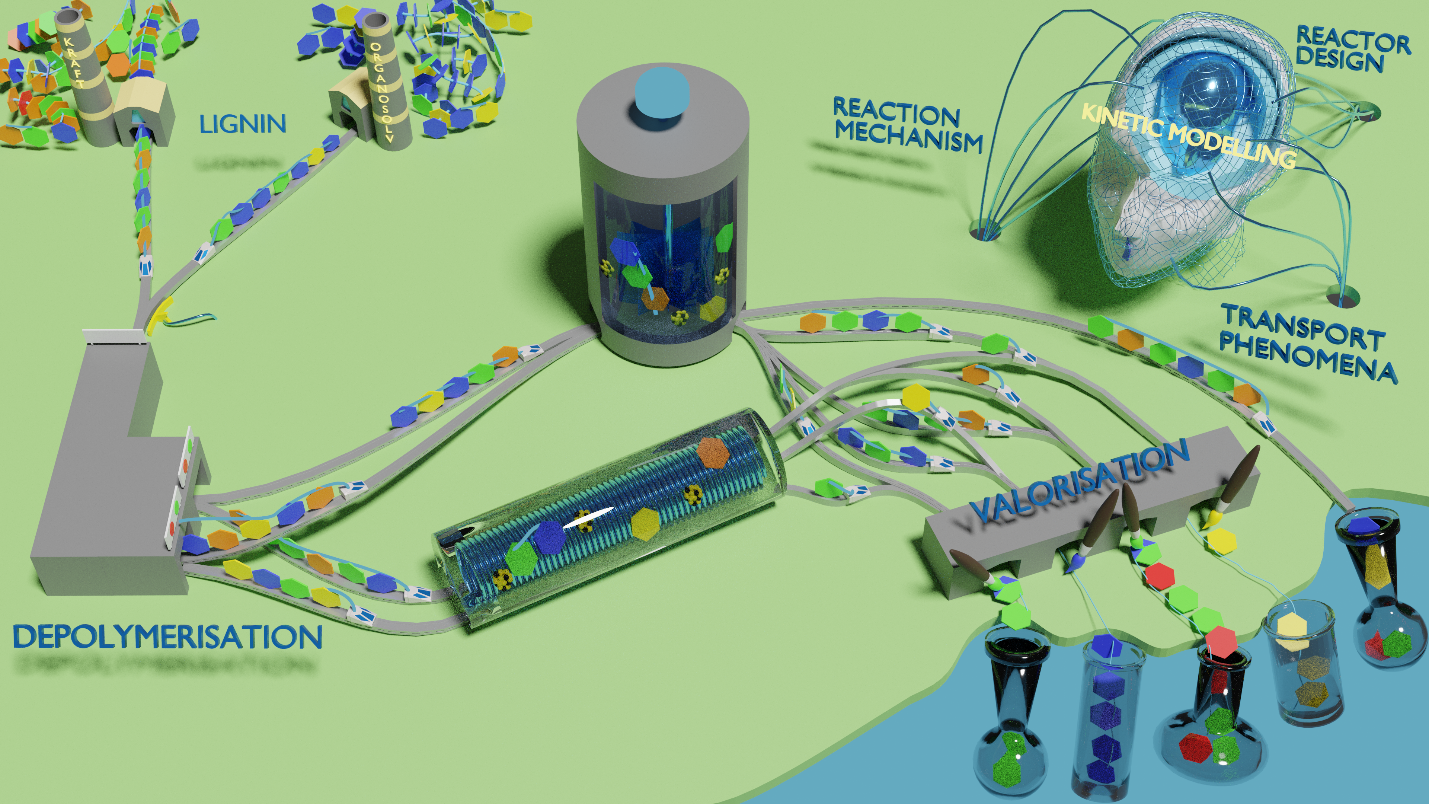
Researchers from the Department of Catalysis and Chemical Reaction Engineering published a review article entitled “Catalytic lignin valorisation by depolymerisation, hydrogenation, demethylation and hydrodeoxygenation: mechanism, chemical reaction kinetics and transport phenomena” in Chemical Engineering Journal (IF 16.7).
The challenges for sustainable chemistry and technology aims to produce energy, fuel and chemicals in a more environmentally friendly way. Lignin is an unwanted constituent in the pulp industry and at the same time a renewable raw material for aromatics. Hence, the research on lignin valorisation has evolved over the last two decades and has been focused on fuels, materials and chemicals as major targets to replace their petroleum-based counterparts.
Engineering approaches developed to utilise lignin includes three aspects: fractionation of lignocellulosic biomass, lignin depolymerisation and upgrading to the platform chemicals. Lignin depolymerisation step is the most challenging and its most straightforward reported pathway involves β-O-4 ether bond cleavage within lignin macromolecule, lignin modification, the removal of various functional groups and condensation reactions due to the formation of reactive hydroxyl groups. With this in mind, the depolymerisation mechanism and kinetic modelling approaches have been investigated in the lignin chemistry research for potential use and implementation at the industrial level.
Kinetic modelling requires specific knowledge, but provides important insight into the behaviour of lignin in the reaction medium with respect to the solvent, catalyst and the reactor used. Kinetic models aim to describe two- or three-phase systems, including the reaction kinetics, transport phenomena and thermodynamics to link experimental data with the theoretical domain. However, kinetic model reported in literature have not been able to describe an overall depolymerisation process without grouped products into kinetic lumps. The limitations have still been observed as high differences between activation energies for overall lignin depolymerisation have been reported.
Computational chemistry and modelling calculations have offered a possibility to predict the reaction course based on a reduced amount of the experiments. Even though the development of lignin kinetic models is in progress, the increasing accuracy of the methods and the development of the more complex controllable systems describing lignin depolymerisation using multiscale modelling will certainly improve lignin valorisation.
This work was funded by the Slovenian Research Agency under research core funding P2-0152 and research project J2-2492.
Link: https://doi.org/10.1016/j.cej.2022.137309
For further information please contact: Tina Ročnik, tina.rocnik(at)ki.si