

Design of new protein scaffolds from multiple chains and their regulation
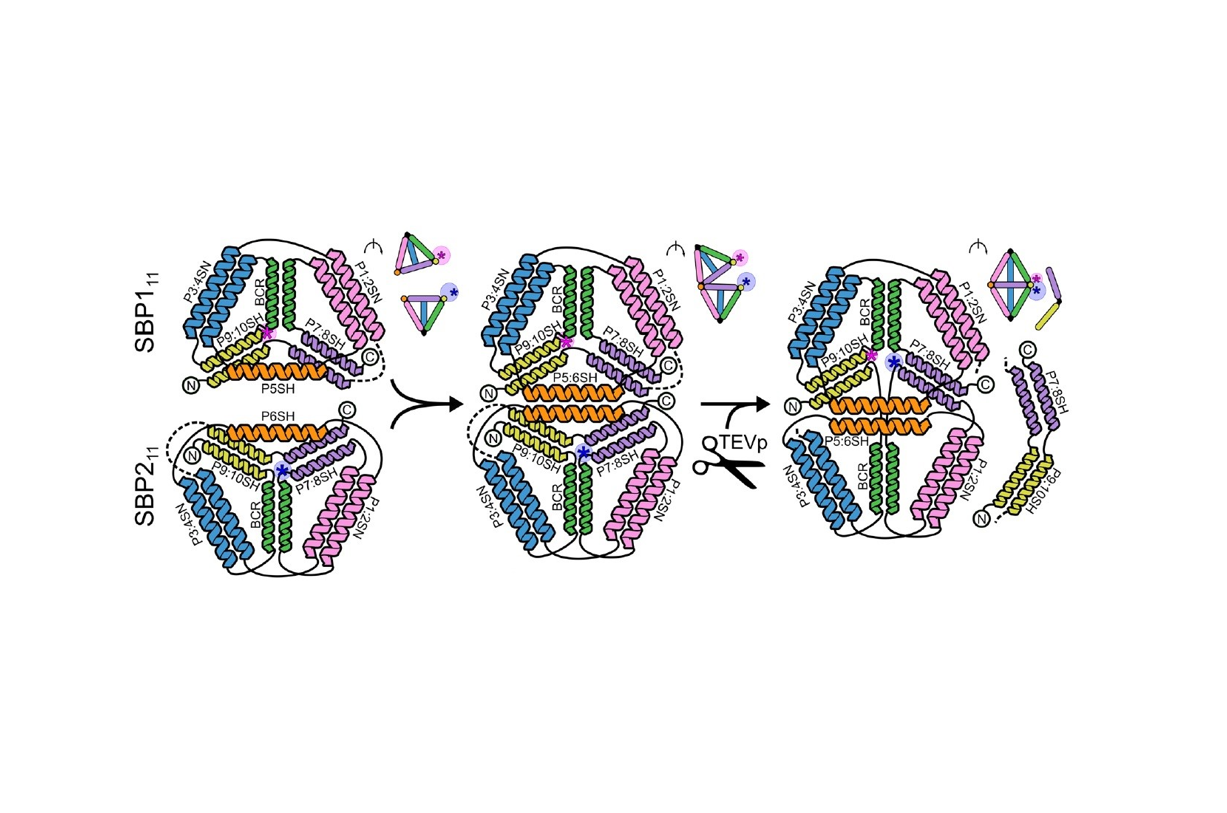
Proteins are key building blocks of all organisms. In recent years, we realized that new protein structures can be constructed based on different architecture than natural proteins. One such example is protein origami from coiled-coils. In this case, the edges of self-assembling protein cages consist of designed coiled coil dimers that are connected into a single polypeptide chain. In this way we designed a tetrahedron, a pyramid and a trigonal prism. Assembly from several polypeptide chains would enable the design of more complex shapes since we could use the same buiding blocks in different chains.
This advance was reported by a team at the National Institute of Chemistry that showed that they can assemble a protein bipyramid from two polypeptide chains in several ways. In addition to designing a new protein fold, they also designed a way to regulate the assembly by an enzyme acting as a trigger.
This research paves the way towards the design of more complex structures, which could be used for delivery and release of drugs, catalysis and for vaccines. The research funded by the ERC AdG project MaCChines led by Roman Jerala, head of the Department of Synthetic Biology at the Institute of Chemistry and Slovenian Research Agency was published in the journal Nature Communications.
The authors of the research are Fabio Lapenta, Jana Aupič, Marco Vezzoli, Žiga Strmšek, Stefano Da Vela, Dmitri I. Svergun, José María Carazo, Roberto Melero and Roman Jerala.
Link: https://www.nature.com/articles/s41467-021-21184-6
For further information please contact: roman.jerala[at]ki.si