

Designed biomolecular liquid condensates based on modular dimeric coiled coils in human cells
Many biological processes in cells must be limited to certain cellular compartments, such as, for example. nucleus or lysosomes so that several processes can run in parallel smoothly and more efficiently. In addition to these membrane-bound compartments, the importance of membraneless cellular compartments containing proteins or nucleic acids that form a separate liquid phase (so-called LLPS) condensates has been recently recognized. These condensates play an important role in many natural and pathological processes, and in recent years, scientists have intensively researched their formation, most often investigating natural components.
Researchers from the Department of Synthetic Biology and Immunology (D12) of the National Institute of Chemistry came up with the idea that they could design cellular protein condensates entirely from modular dimeric coiled-coils (CC). Research group from D12 has a long-lasting expertise with these building blocks and have used them to introduce many ways of regulating cellular processes or preparing new proteins (e.g. https://www.nature.com/articles/s41467-023-38697-x, https:// www.nature.com/articles/s41467-022-31386-1, https://www.nature.com/articles/s41589-018-0181-6, https://www.nature.com/articles/s41467-021-21185-5 ... ).
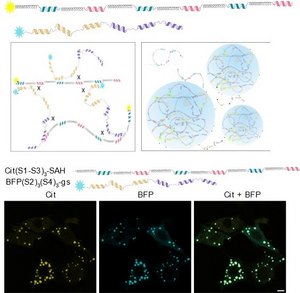
Principles and experimental confirmation of designed coiled-coil-based liquid condensates in human cell line.
In the spirit of synthetic biology, the formation of artificial LLPS condensates could provide new insights into the principles of LLPS formation, and on the other hand, systems with new interesting properties could be obtained. Indeed, they were able to prepare LLPS condensates in human cell lines by engineering two chains containing multiple repeats of CC dimer-forming segments, leading to the formation of condensates in mammalian cells. For this, destabilized CC building blocks were prepared, which enabled the dynamic exchange and formation of the liquid phase. They found that higher stability modules led to rigid aggregates, while less stable building blocks dis not form condensates. With a modular system, they successfully designed condensates that form, disintegrate, merge or enable the coexistence of different condensates in the cell in a controlled manner. The findings of this research provide insight into the principles underlying liquid phase separation and a new platform for the design and control of biological processes. In addition to two-component systems, based on the knowledge of CC properties, they also managed to prepare LLPS from a single polypeptide chain, and, on the other hand, by adding a third polypeptide chain, they were able to dissolve condensates, thus opening the way to control cellular processes for the potential use in biotechnology, preparation of new materials or in in biomedicine.
In the research, led by prof. Roman Jerala, PhD student Maruša Ramšak performed the key role, other researchers from the National Institute of Chemistry and the University of Colorado, Boulder from the USA participated, contributing simulation of the formation of condensates from modular building blocks. The research paper was published in the journal Nature Communications. Researchers from NIC were funded by ARIS and ERC AdG project MaCChines.
Ramšak, M., Ramirez, D.A., Hough, L.E., Shirts, M.R., Vidmar, S., Eleršič Filipič, K., Anderluh, G. & Jerala, R. Programmable de novo designed coiled coil-mediated phase separation in mammalian cells. Nat Commun 14, 7973 (2023). https://doi.org/10.1038/s41467-023-43742-w