

Determination of oxidized lysophospholipids in extracellular vesicles as promotors of sterile inflammation in arthritis and other inflammatory diseases
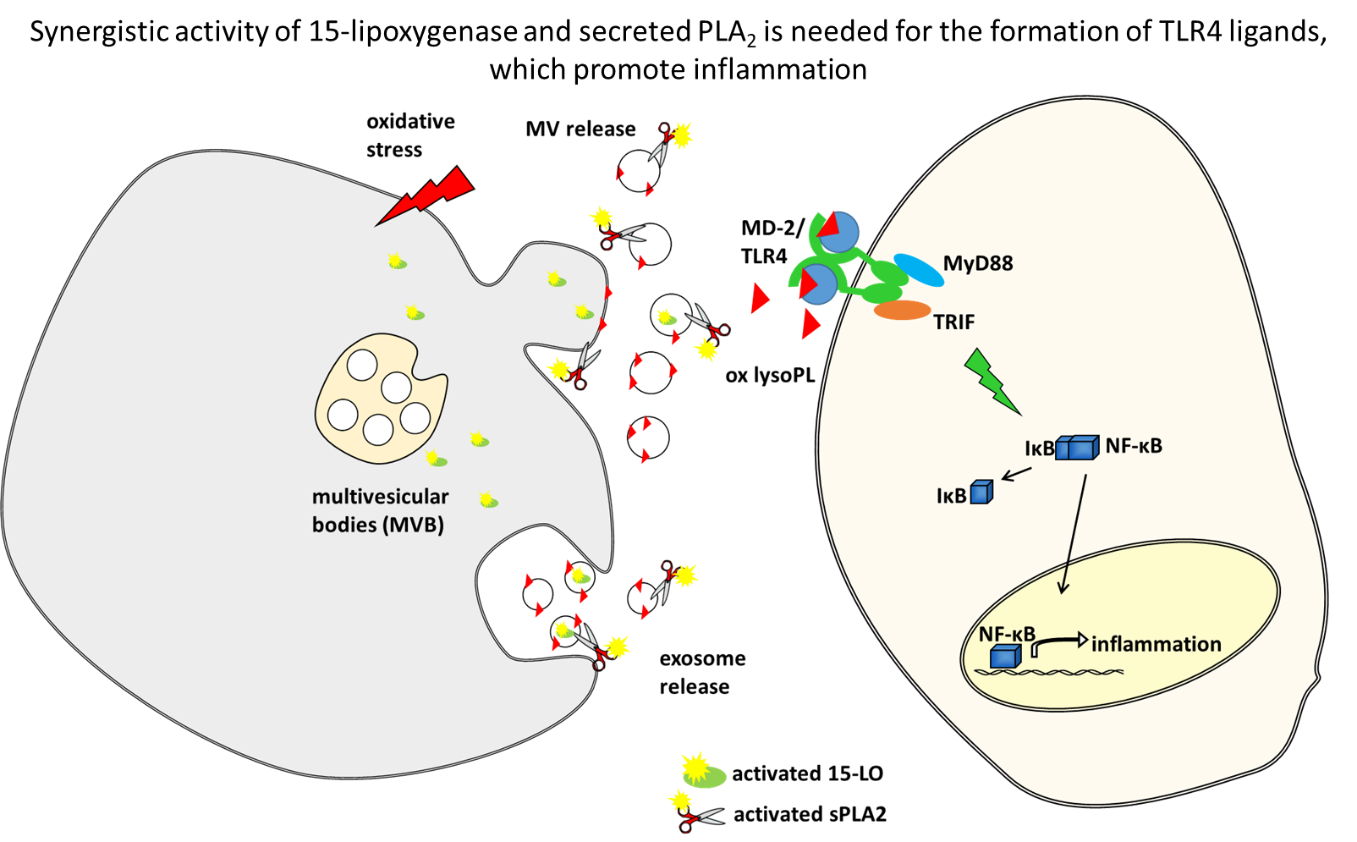
Sterile inflammation is a physiological condition, which develops in the absence of a microbial infection as a result of tissue damage, but also underlies the pathogenesis of many chronic diseases. Sterile inflammation involves increased production of oxygen reactive species, which are part of the oxidative stress. One of the main features of oxidative stress is increased phospholipid peroxidation thus defining them as potential DAMPs (damage-associated molecular patterns).
The researchers from Department of Synthetic Biology and Immunology from National Institute of Chemistry with collaborators under leadership of Dr. Mateja Manček Keber showed that extracellular vesicles, released under oxidative stress, activate important innate immune receptor TLR4, but differently than its bacterial ligand lipopolysaccharide, underlying the differences between pathogen-induced and sterile inflammation.
We showed that synergistic activities of 15-lipoxygenase (15-LO) and secreted phospholipase A2 (sPLA2) are needed for the formation of TLR4 agonists, which were identified as lysophospholipids with oxidized unsaturated acyl chain. 15-LO oxidation products activated the cells similarly as stressEVs. Extracellular phospholipase activity was detected in the synovial fluid from rheumatoid arthritis and gout patients and was needed for agonist formation. Furthermore, injection of recombinant sPLA2 promoted arthritis in mice, whereby ankle swelling was partially TLR4-dependent. Results confirm the role of oxidized lysophospholipids, released in the form of extracellular vesicles, in sterile inflammation that may promote chronic diseases. Both 15-LO and sPLA2 are enzymes induced during inflammation, which opens the opportunity for therapy without compromising innate immunity against pathogens.
The results are published in the paper titled Synergy between 15-lipoxygenase and secreted PLA2 promotes inflammation by formation of TLR4 agonists from extracellular vesicles in Proceedings of the National Academy of Sciences (https://www.pnas.org/content/early/2020/09/23/2005111117).
The authors of the research are Van Thai Ha, Duško Lainšček, Roman Jerala and Mateja Manček Keber from National Institute of Chemistry, Eva Jarc-Jovičić and Toni Petan from Institute of Jožef Stefan, Bernd Gesslbauer and Valery Bochkov from University of Graz, Austria, Nejc Ilc from Faculty of Computer and Information Science, Katja Lakota and Matija Tomšič from University Medical Centre Ljubljana, Fons A.J. van de Loo from Radboud University Medical Center, The Netherlands and Tuulia Hyötyläinen from Örebro University, Sweden.
For further information please contact: mateja.mancek(at)ki.si