

DFT study of electrolyte stability and reactivity in the double layer
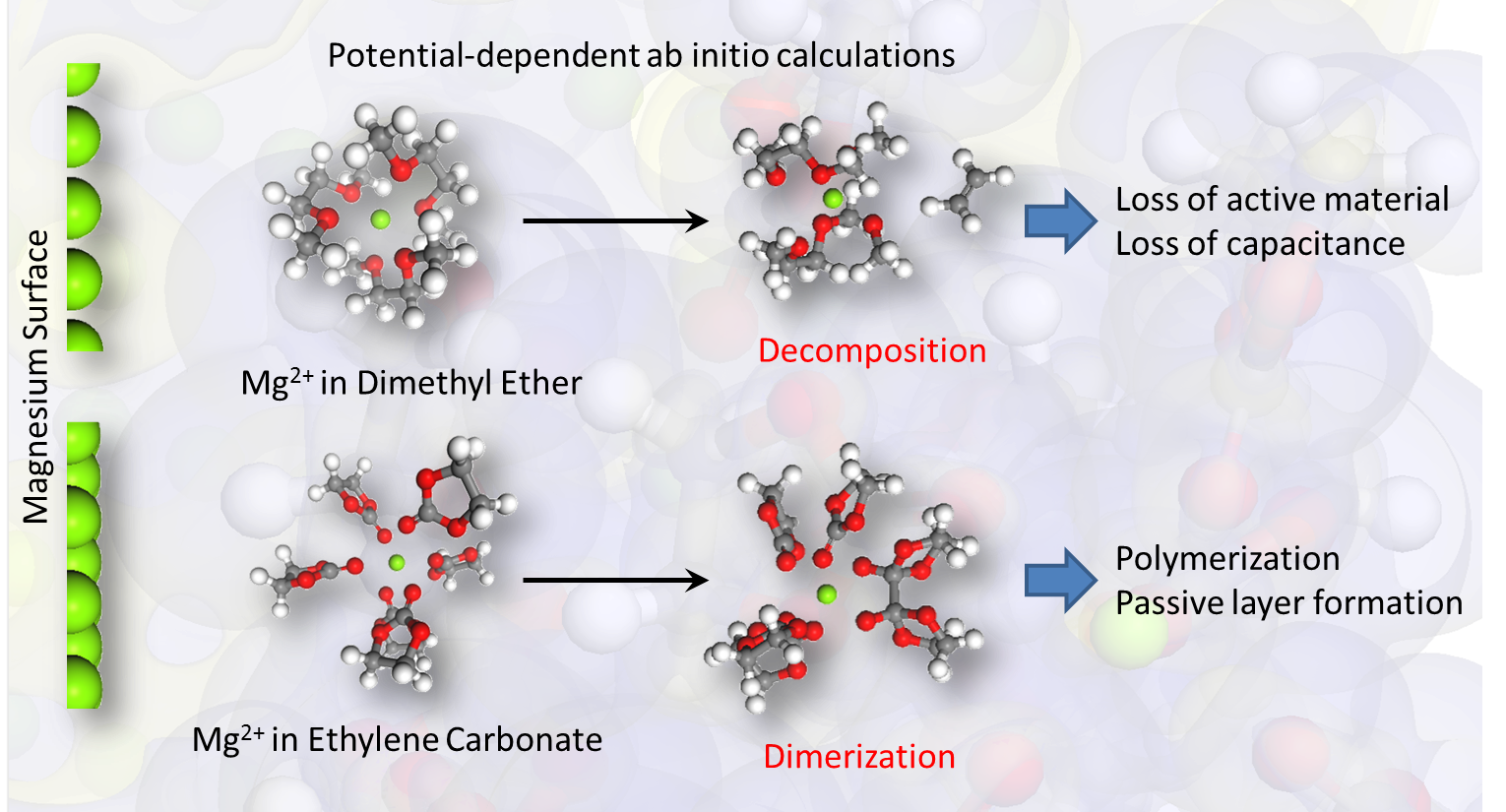
Ljubljana, February 18th, 2020 – Researches from the National Institute of Chemistry (Department of Materials Chemistry) in collaboration with the Jožef Stefan Institute and the Institut Charles Gerhardt Montpellier report on a new theoretical approach that considers potential dependence at the atomistic level. The methodology, which is transferable to all electrochemical systems, enables understanding and optimization of the processes in the double layer. The research was published in the renowned Journal of the American Chemical Society.
The processes in the double layer of an electrode are complex and difficult to model due to large electric fields. At the same time, all the electrochemistry governing how the system will work is occuring in this region. A new theoretical DFT approach that considers the influence of the potential at the atomistic level is therefore an important step in the field of electrochemistry.
The methodology is applied to two magnesium electrolytes. The obtained results enable understanding of the stability and reactivity of the electrolytes in the double layer of magnesium anode. It is shown that the electrolyte molecules decompose in the double layer, prior to reaching the surface of the anode. Decomposition products, which depend on the type of electrolyte, provide insights on whether or not the system will work. Furthermore, conclusions made from theoretical results will be used in practice to improve electrolytes for Mg batteries.
The work was done by researchers from the Department of Materials Chemistry (D10) (A. Kopac Lautar, J. Bitenc and R. Dominko) in collaboration with the Institut Charles Gerhardt Montpellier (J.-S. Filhol and M.-L. Doublet), and the Jožef Stefan Institute (T. Rejec). The research was published in JACS in an article entitled "Electrolyte Reactivity in the Double Layer and Mg Batteries: An Interface Potential-Dependent DFT Study.
Link to the article: https://pubs.acs.org/doi/pdf/10.1021/jacs.9b12474