

Electrostatics is the driving force behind enzyme catalysis
Hypothesis confirmed on the case of monoamine oxidase a enzyme by quantum computations
ALJA PRAH, ERIC FRANČIŠKOVIĆ, JANEZ MAVRI, JERNEJ STARE
THEORY DEPARTMENT, LABORATORY FOR COMPUTATIONAL BIOCHEMISTRY AND DRUG DESIGN
While the catalytic function of enzymes has been well known to researchers for decades, the driving force behind it is still a hotly debated topic. The views on this fundamental issue are condensed around the following two hypotheses: (1) catalytic function originates from preorganized electrostatics; and (2) catalytic function is driven by nonequilibrium dynamical effects. The study of Theory Department researchers recently published in ACS Catalysis, a premium journal in the respective field, gives strong evidence in favor of the first hypothesis.
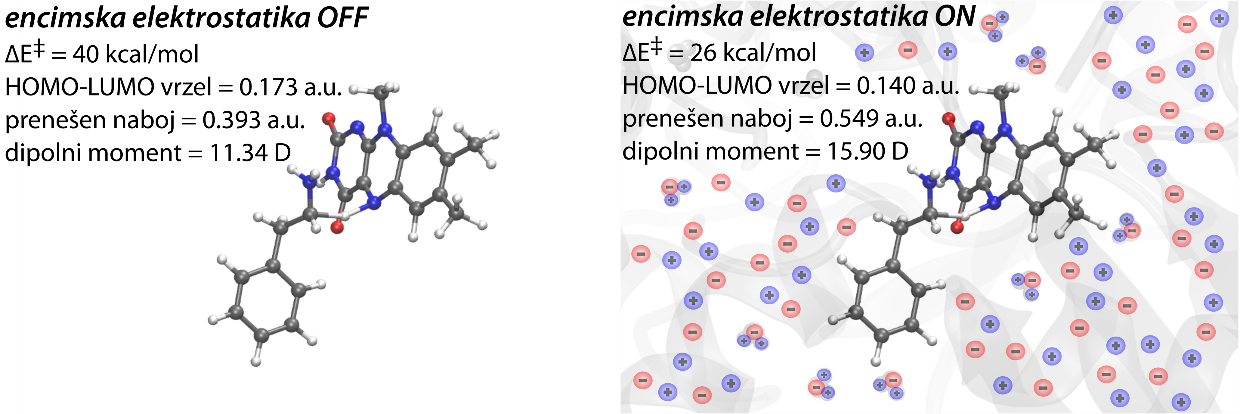
We developed a simple and inexpensive, yet efficient multiscale computational model based on the treatment of the reacting moiety by quantum chemistry, embedded in the enzymatic environment represented by atomic point charges. The approach facilitates investigation of the influence of the enzyme’s electrostatics on the electronic structure of the reacting subsystem, thereby assessing some vital aspects of reactivity and kinetics. Importantly, the approach allows for simple manipulation with the electrostatic environment – the charges can be (selectively or entirely) switched off, scaled, displaced or otherwise modified – giving insight into the role of electrostatics in enzymatic reactions.
We applied the above described model to the selected reaction (catalytic step of phenylethylamine oxidation by the monoamine oxidase A enzyme), represented by 100 snapshot structures corresponding to reactants, and 100 snapshot structures corresponding to the transition state.
By switching the enzyme’s point charges ON and OFF we demonstrated that electrostatics exhibits decisive catalytic influence by all the considered criteria. Namely, on inclusion of enzyme’s electrostatics the reaction barrier drops by 14 kcal/mol, the charge transfer increases by 40% and the HOMO-LUMO gap pertinent to the reaction decreases by 20%. The catalytic function of the enzyme is rationalized by the stabilizing interaction between the dipole moment of the reacting moiety and the electric field exerted by the charged environment that is noticeably stronger in the transition state than in reactants, thereby lowering the barrier. Our findings support the view that catalysis in enzymes originates from preorganized electrostatics, i.e. enzymes are evolutionary designed in such a way that they, by electrostatic interactions, lower the free energy barrier, resulting in the significantly increased reaction rates.
ACS Catalysis, 2019, 9, pp 1231–1240 DOI: 10.1021/acscatal.8b04045
Full article is available at the following link: http://dx.doi.org/10.1021/acscatal.8b04045