

Electrocatalytically amplified immunosensing of PSA
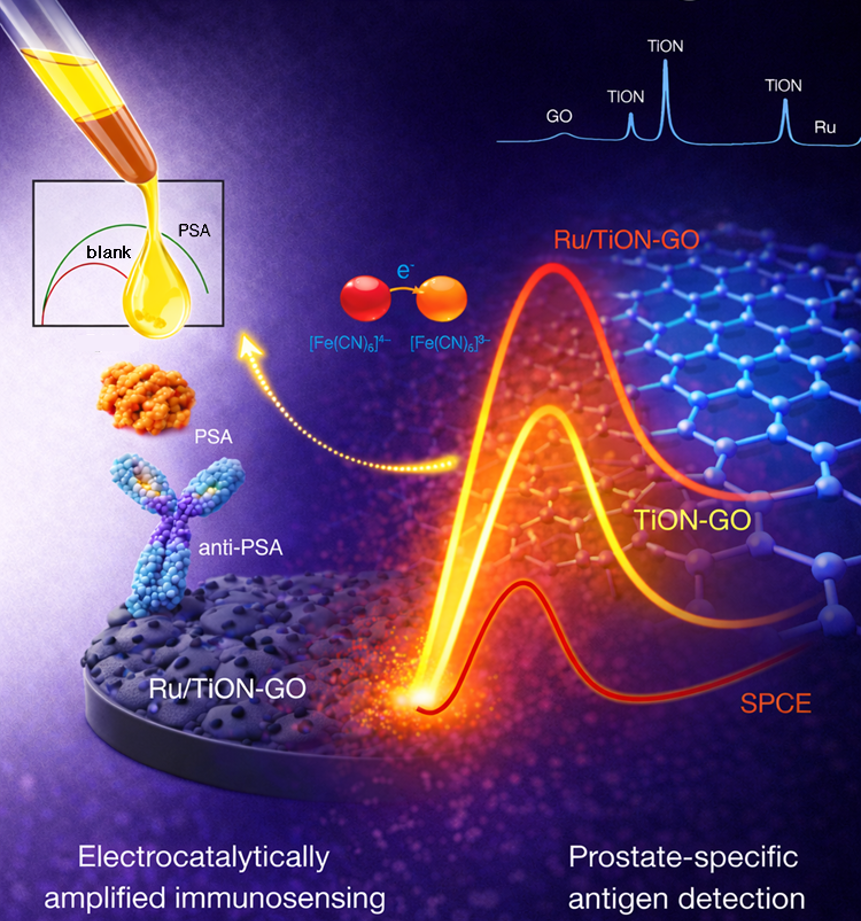
Electrocatalytically-amplified electrochemical immunosensing offers a promising approach for the sensitive and selective detection of clinically relevant biomarkers. In this study, the authors developed a high-performance electrochemical immunosensor for prostate-specific antigen (PSA) based on a hierarchical hybrid nanostructure consisting of ruthenium (Ru) nanodots anchored onto titanium oxynitride (TiON) nanoflakes dispersed on graphene oxide (GO), forming a Ru/TiON-GO nanocomposite. The nanocomposite was further functionalized with APTES to enable the immobilization of the biorecognition components.
The engineered hybrid architecture exhibits enhanced electrocatalytic activity, which is attributed to the synergistic interaction between the Ru nanodots and the conductive TiON-GO support. This architecture facilitates electron transfer at the electrode/solution interface and enhances the electrochemical response of the hexacyanoferrate redox probe. Taking advantage of these properties, the researchers developed an impedimetric immunosensor for PSA detection. The immunosensor achieved a limit of detection of 0.06 ng mL⁻¹ (2.3 pM) in serum and a broad response range covering clinically relevant PSA concentrations.
Importantly, the immunosensor demonstrated high selectivity when tested in human serum, with its analytical response remaining largely unaffected by the presence of common potentially interfering biomolecules. These results highlight the potential of the developed electrochemical platform for sensitive and selective biomarker detection in complex biological samples.
To gain deeper insight into the origin of the enhanced electrocatalytic activity, density functional theory (DFT) calculations were performed. Charge density difference maps and density-of-states analysis revealed significant electron redistribution associated with the Ru domain and an increased density of electronic states near the Fermi level. These findings provide a theoretical basis for the experimentally observed improvement in electroanalytical performance. Overall, the combination of rational nanomaterial design, experimental electrochemistry, and theoretical modeling offers new opportunities for developing sensitive and selective electrochemical diagnostic tools.
The research was conducted by doctoral candidate Mitja Koderman, Dr. Filip Cernatič, Dr. Samo Hočevar, and Dr. Nikola Tasić from the Department of Analytical Chemistry (D04), National Institute of Chemistry; Dr. Milutin Smiljanić, Dr. Marjan Bele, Dr. Francisco Ruiz-Zepeda, and Dr. Nejc Hodnik from the Department of Materials Chemistry (D10), National Institute of Chemistry; and Prof. Dr. Mitja Kolar from the Faculty of Chemistry and Chemical Technology, University of Ljubljana, Slovenia.
The results have been published in the journal Small (Journal Impact Factor (2026): 11.8).
Link to publication: https://doi.org/10.1002/smll.74840
Contact: dr. Samo Hočevar, samo.hocevar@ki.si