

Engineering modular digital logic into human cells

We cannot imagine our life without electronic digital computers, which perform many different tasks from processing text to the control of devices from cars to mobile phones. Those tasks are performed by electronic computers based on the elementary binary logic operations performed by electronic circuits which comprise a large number of logic gates of the same type.
Cells of the living organisms are also continuously processing a large number of signals from the environment and convert them into an appropriate response, which allow the organisms to survive. If we want to engineer cells to reliably perform the set tasks, such as for example to act as sensors that monitor the health of the organism and produce the appropriate therapeutic proteins, then we need to introduce the processing logic that could perform logical operations independently of the existing cellular processes. In comparison to electronic circuits cells are unable to relay information through conductive wires as in electronic circuits, but only through biological molecules that can freely diffuse within cells. This prevents the repeated use the same type of the logic gate and we rather need many independently functioning genetic logic gates or many different transcription factors that mediate information within cell corresponding to the flow of electricity in electronic circuits.
Researchers already designed digital logic gates in cells using transcription factors isolated from natural organisms such as bacteria. The availability of natural transcription factors and their interactions with the genome and proteins of the cell limits the complexity of designed genetic logic circuits.
Now group of Slovenian researchers from the National Institute of Chemistry and Centre of Excellence EN- FIST proposed in a paper published in the advanced online publication in Nature Chemical Biology a new strategy that could allow design of more complex cellular circuits mimicking the design principles used in electronic circuits. The key advance was to use a group of protein domains called TALEs (Transcription activator-like effectors) that can be designed to bind to almost any DNA sequence, in principle millions of different varieties. This provides a large number of independent wires for complex genetic circuits. In analogy to electronic TTL circuits researchers constructed a genetic NOR gate. This gate that requires 2 TALE based transcription factors has a special advantage that any type of logic circuit can be made from only a combination of NOR gates. They demonstrated this by constructing all 16 logic operations in human cells. They demonstrated that this type of genetic circuits requires even smaller number of NOR gates than their electronic counterparts.
Research was performed by Rok Gaber, Tina Lebar PhD students in the lab of prof. Roman Jerala at the Department of Biotechnology, in collaboration with Mojca Benčina, Andreja Majerle, Branko Šter and Andrej Dobnikar, the last two computer scientists from the University of Ljubljana.
Researchers point out that the main advantage of their approach is that it is scalable as they can introduce parallel independently operating circuits into each cell. Head of the group prof. Jerala notes "The processor at the heart of the guidance controller of the Apollo rocket was only composed of triple input NOR gates." The genetic logic won’t likely replace the electronic circuits; nevertheless they could be valuable in biological sensors and for engineering of the therapeutic cells.
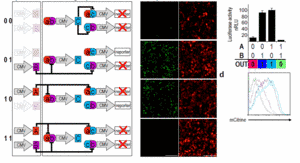
Example of genetic logic circuit prepared by a combination of NOR gates composed of designed DNA binding domains (differently colored DNA binding domains). Output of one gate represents input to a NOR gate in the next layer, allowing design of complex logic genetic circuits. This particular circuit performs XOR logic operation, which results in an active output if the two inputs are different.