

Explanation of weak ergodicity breaking in superdiffusive dynamics

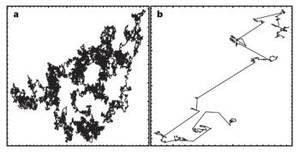
(a) Trajectory of a particle undergoing (normal) diffusion (b) trajectory of a particle during a Lévy-stable random walk.
Due to an unfeasible number of dynamical degrees of freedom or a lack of knowledge about the actual microscopic dynamics an exact deterministic description of complex dynamical systems is often not possible. Therefore, one is forced to an effective stochastic description. Traditionally it is assumed that the noise follows Gaussian statistics, which is based on the central limit theorem.
Among the most famous members of such processes is Brownian motion or diffusion (see Figure - left panel). It is known that Gaussian statistics are merely a specific case of more general stable statistics, for which there exists a generalized central limit theorem. Among others, stable statistics of underlying dynamical increments were found in intermittent chaotic systems, diffusion in Josephson junctions, dispersion of light in inhomogeneous media, blinking of quantum dots, movement patterns of T-cells in the brain and even in the motion patterns of animals and humans.
Based on analytical calculations supported by numerical simulations Dr. Aljaž Godec (a researcher of the Laboratory L10 on a postdoctoral training at the Institute of Physics and Astronomy, University of Potsdam, Germany) and Prof. Ralf Metzler (Institute of Physics and Astronomy, University of Potsdam) explain that the scatter of time averages over an ensemble of trajectories of finite length is a direct consequence of the underlying Lévy-stable statistics of the noise. The finiteness of trajectories necessarily leads to weak ergodicity breaking even if the trajectories are several orders of magnitude longer that the characteristic timescale of the elementary dynamical increments. The authors derive an exact relationship between the average of time-averaged quantities over an ensemble of finite trajectories and their (thermodynamic) ensemble average. Recent experimental results confirm their theoretical predictions.
The work was published in Physical Review Letters (impact factor 7.37).