

The Dual Role of Light in a Photocatalyst for Water Purification
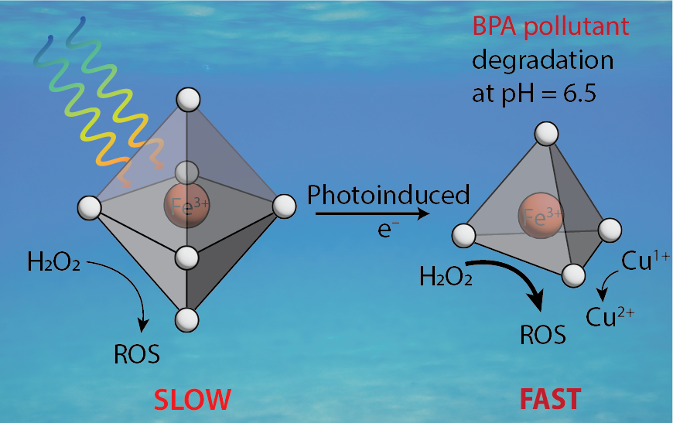
Advanced Oxidation Processes (AOPs) represent sustainable and efficient technologies for water treatment, with the Fenton process standing out as one of the most practical approaches. Recent research increasingly emphasizes solar-driven AOPs and the deeper understanding of the complex mechanisms that govern their performance. In this work, we evaluate mono- and bimetallic (Cu and/or Fe) catalysts, supported on porous silica with interparticle mesoporosity, in visible light driven photo-Fenton like systems for the degradation of the model contaminant bisphenol A (BPA). The most effective CuFe catalyst achieves complete BPA removal in 90 minutes and retains stable performance over four consecutive cycles.
Introducing light significantly enhances the catalytic activity of the bimetallic CuFe system. Our findings demonstrate that visible light plays a dual mechanistic role: it drives electronic processes (e.g. charge carrier generation and redox cycling) while simultaneously triggering a coordination rearrangement of Fe centers. The novelty lies in establishing a structure-property-activity relationship supported by in situ structural evidence and introducing light-activated coordination dynamics as a new mechanistic and design principle for heterogeneous AOP catalysts, beyond that of simply combining Cu and Fe or use of visible light alone.
Understanding the structure–property–activity relationships in such bimetallic oxide catalysts has implications beyond water purification and could benefit air purification, heterogeneous catalysis, green chemistry, advanced manufacturing, electrocatalysis and photocatalysis.
Researchers from the Department of Inorganic Chemistry and Technology (D09) – Andraž Šuligoj, Ksenija Maver, Nataša Zabukovec Logar, Albin Pintar and Nataša Novak Tušar – together with a co-author from the Department of Materials Chemistry (D10) and a co-author from the University of Nova Gorica, have published their research findings in the journal Energy & Environmental Materials
(IF = 13.8).
Link to article: https://onlinelibrary.wiley.com/doi/epdf/10.1002/eem2.70400
Contact: dr. Nataša Novak Tušar, natasa.novak.tusar@ki.si