

Hybrid programmable materials combining the advantages of DNA and proteins
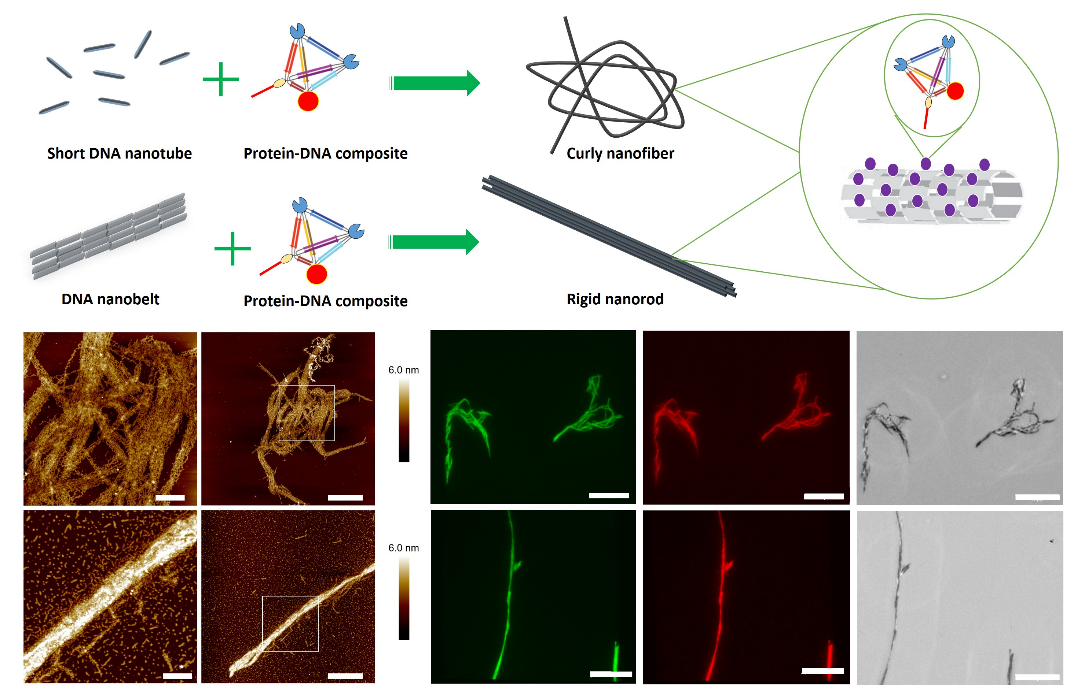
Advances in nanotechnology have increasingly drawn upon the unique properties of biomolecules to construct programmable and multifunctional materials. Among these, DNA nanotechnology has emerged as a powerful tool for building nanoscale structures with high precision, utilizing the predictable nature of base-pairing interactions. Parallel to this, protein engineering offers access to the rich chemical and functional diversity inherent to amino acids, enabling the creation of dynamic and functional biological materials. This study bridges these two complementary paradigms by introducing a modular platform for creating hybrid protein-DNA nanostructures that combine the structural programmability of DNA with the functional versatility of proteins.
Utilizing orthogonal conjugation strategies—specifically the SpyCatcher/SpyTag system for protein-protein bonding and a DCV endonuclease domain for protein-DNA coupling—the authors designed tetrahedral protein scaffolds capable of precise multivalent functionalization. These engineered composites self-assemble into well-defined nanostructures, including nanofibers and nanorods, which can be tailored through buffer conditions and nucleic acid sequences. The hybrid assemblies not only exhibit stable morphologies but also retain functional attributes such as enzymatic activity and fluorescence. Furthermore, the introduction of a DNA-mediated split-luciferase circuit demonstrates a dynamic regulatory mechanism, showcasing reversible control over enzymatic function via strand displacement reactions.
This integrated platform presents a significant step forward in bio-nanomaterials, offering a versatile and programmable system for the creation of responsive, multifunctional nanoscale devices with potential applications in diagnostics, synthetic biology, and smart biomaterials. The authors of the paper are current and former members of the Department of Synthetic Biology and Immunology at the National Institute of Chemistry (Weijun Zhou, Žiga Strmšek, Jaka Snoj, Roman Jerala), and J. Stefan Institute (Slovenia).
The article was published in Small (https://doi.org/10.1002/smll.202502060).
Contact for more information: roman.jerala(at)ki.si