

Hybrid Pt/FeNC fuel-cell catalysts with improved stability
Platinum group metals (PGM) free catalysts have high initial activity for O2 reduction reaction, but they suffer from low stability in an acid medium in proton exchange membrane fuel cells (PEMFC) and direct methanol fuel cells (DMFC).
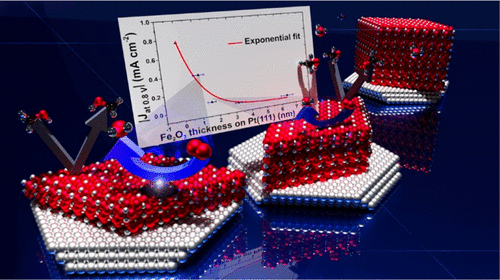
Authors from the University of Padova, University of Montpellier and National Institute of Chemistry studied the atomic-scale structure of hybrid Pt/FeNC catalysts (1−2 wt % of Pt), revealing, via scanning tunnelling and transmission electron microscopy and energy-dispersive X-ray spectroscopy, the presence of Pt@FeOx particles. The absence of exposed Pt on the surface is confirmed by the suppression of methanol oxidation reaction and CO stripping experiments. The promising application of such Pt/FeNC catalysts, comprising FeNx sites and Pt@FeOx particles, is demonstrated at the cathode of DMFC. To gain fundamental understanding on the stability in acid medium and on the intrinsic ORR activity of Pt@FeOx, the authors constructed model surfaces by depositing FeOx films with a controlled thickness (from 1.0 nm to 6.4 nm), fully covering the Pt(111) surface, which resulted stable in the acid medium in the potential range of 0.45−1.05 V vs RHE. The specific ORR activity of Fe2O3/Pt(111) increases exponentially with decreasing overlayer thickness, which is explained by the tunnelling of Pt electrons through Fe2O3.
This special phenomenon sheds light onto recently reported excellent durability of Pt/FeNC composites in PEMFC and identifies a promising core-shell strategy leading to stable PGM-free surfaces in acid medium, and tolerant to methanol.
ONLINE LINK
https://pubs.acs.org/doi/10.1021/acscatal.0c01288