

Insight into the folding pathway of modular proteins and its application for the protein design

Structure prediction and design of smaller protein domains have advanced remarkably. On the other hand, understanding of the process of protein folding into its tertiary structure is still an unsolved problem that is however crucial for larger proteins and diseases, where this process is disturbed. Researchers at the National institute of chemistry analyzed the folding pathway of coiled-coil protein origami (CCPO) cages which could be used to guide the design of this process.
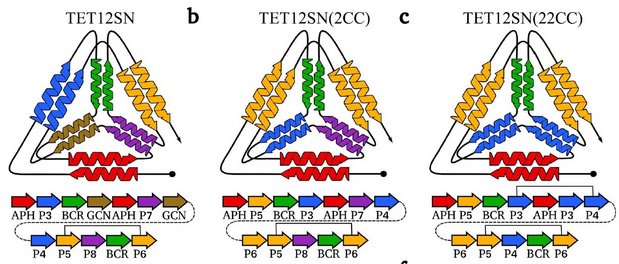
By analyzing the assembly of a protein tetrahedron, they found that pairs of modules that are close in space are assembled first. A simple mathematical model was prepared which allowed them to use the same module multiple times because the design of the sequence of modules can control the assembly of correct pairs. Using those rules, they prepared a protein tetrahedron composed of 12 connected CC segments where instead of six different pairs only three pairs were sued, which thus appeared twice and the polypeptide sequence, which led to the correct protein assembly with favorable properties. In addition to being used for the design of modular CCPO proteins, this principle could provide an insight into the folding pathway of natural repetitive proteins and likely also for DNA nanostructures.
The research was funded through the MaCChines ERC project led by Roman Jerala, Head of the Department of Synthetic Biology at the Institute of Chemistry and Slovenian Research Agency and published in the journal Nature Communications.
The authors of the research were Jana Aupič and Žiga Strmšek, who share the first authorship and coauthors Fabio Lapenta, David Pahovnik, Tomaž Pisanski, Igor Drobnak, Ajasja Ljubetič and Roman Jerala.
Link:https://www.nature.com/articles/s41467-021-21185-5
For further information please contact: roman.jerala[at]ki.si