Improving the HER Activity and Stability of Pt Nanoparticles by Titanium Oxynitride Support
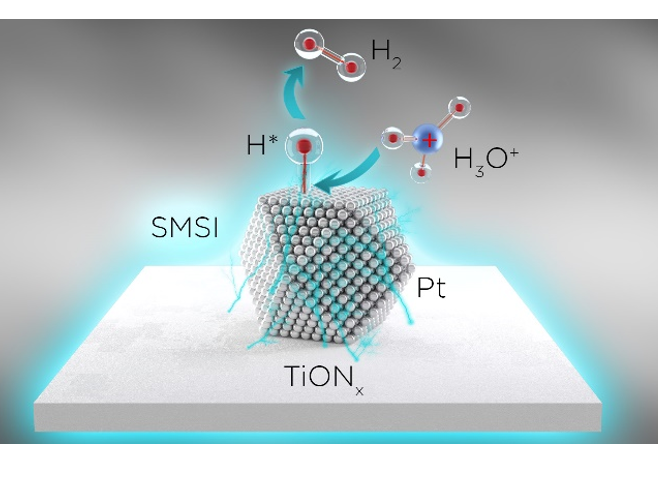
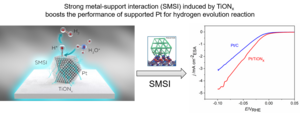
Water electrolysis powered by renewables is regarded as the feasible route for the production of hydrogen, obtained at the cathode side through an electrochemical hydrogen evolution reaction (HER). Herein, we demonstrate a strategy to enhance the overall HER catalytic performance of Pt, which is the best monometallic catalyst for this reaction, by supporting it on a conductive titanium oxynitride (TiONx) dispersed over reduced graphene oxide nanoribbons. The Pt/TiONx nanocomposite exhibited improved HER activity and stability with respect to the Pt/C benchmark in an acid electrolyte, which was ascribed to the strong metal–support interaction (SMSI) triggered between the TiONx support and Pt nanoparticles. SMSI between TiONx and Pt was evidenced by X-ray photoelectron spectroscopy (XPS) through a shift of the binding energies of the characteristic Pt photoelectron lines with respect to Pt/C. Density functional theory (DFT) calculations confirmed the strong interaction between Pt nanoparticles and the TiONx support, which resulted in enhanced overall HER performance of Pt/TiONx composite.
For financing the research, the authors acknowledge the support by Slovenian Ministry of Education Science and Sport & EU─European Regional Development Fund, Slovenian research agency (ARRS), European Research Council (ERC) as well as NATO Science for Peace and Security Program.