

Janus nanocellulose membrane by nitrogen plasma
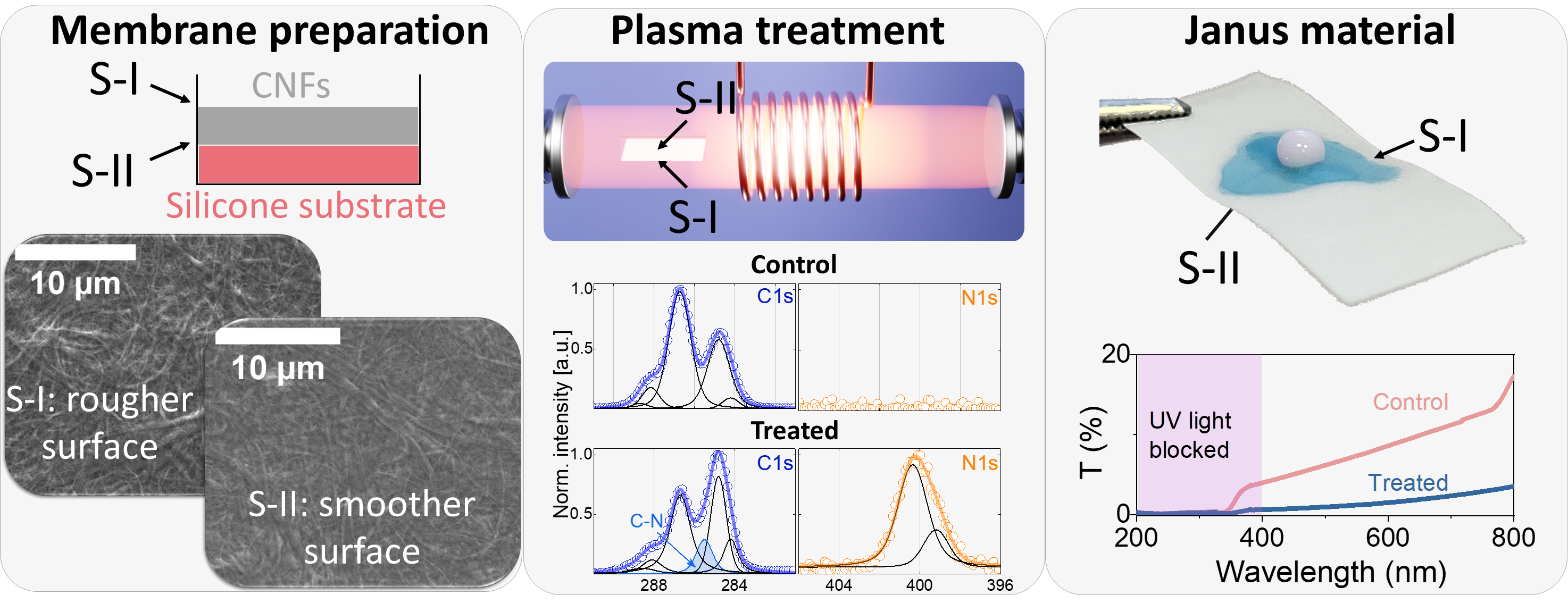
Due to their origin from the most abundant biopolymer on Earth, biodegradability, biocompatibility, and exceptional mechanical properties, cellulose nanofibrils represent one of the key materials for a sustainable future. However, their poor water resistance currently poses a barrier to their broader use in the packaging and textile industries. Existing methods for the hydrophobization of nanocellulose are complex, economically costly, and/or toxic. In contrast, plasma allows for quick and precise surface hydrophobization in a single step.
In the study, preparation of Janus membranes based on cellulose nanofibrils through one-sided selective activation of water repellency using mild nitrogen plasma treatment was demonstrated. Hydrophobicity and Janus character that were achieved after only 20 seconds of exposure can be explained by topological, chemical, and structural reorganizations in the cellulose nanofibrils. The mechanism responsible for the change in surface wettability is based on the removal of OH, the presence of Si-CH3 bonds, and the formation of C-NH2 groups. We complemented the experimental findings with ab initio calculations, which showed that while C-NH2 groups increase hydrophobicity, various Si-CH3 substitutions can completely change the surface character. We also demonstrated that the use of nitrogen in plasma is crucial, as N(H)-Si-(CH3)3 groups induce greater hydrophobicity than the simple O-Si-(CH3)3 groups obtained when using oxygen plasma. Materials prepared using the presented method repel water on the hydrophobic side while remaining hydrophilic on the other, exhibiting high tensile strength and UV protection, which demonstrates their applicability in a wide range of applications.
The study was published in journal Carbohydrate Polymers and was conducted in collaboration of Department of Catalysis and Chemical Reaction Engineering (NIC), Department of Materials Chemistry (NIC) and Department of Gaseous Electronics (IJS).
LINK: https://doi.org/10.1016/j.carbpol.2024.122558
Contact: ana.oberlintner(at)ki.si