

What Drives the Antioxidant Capacity of Edible Insects?
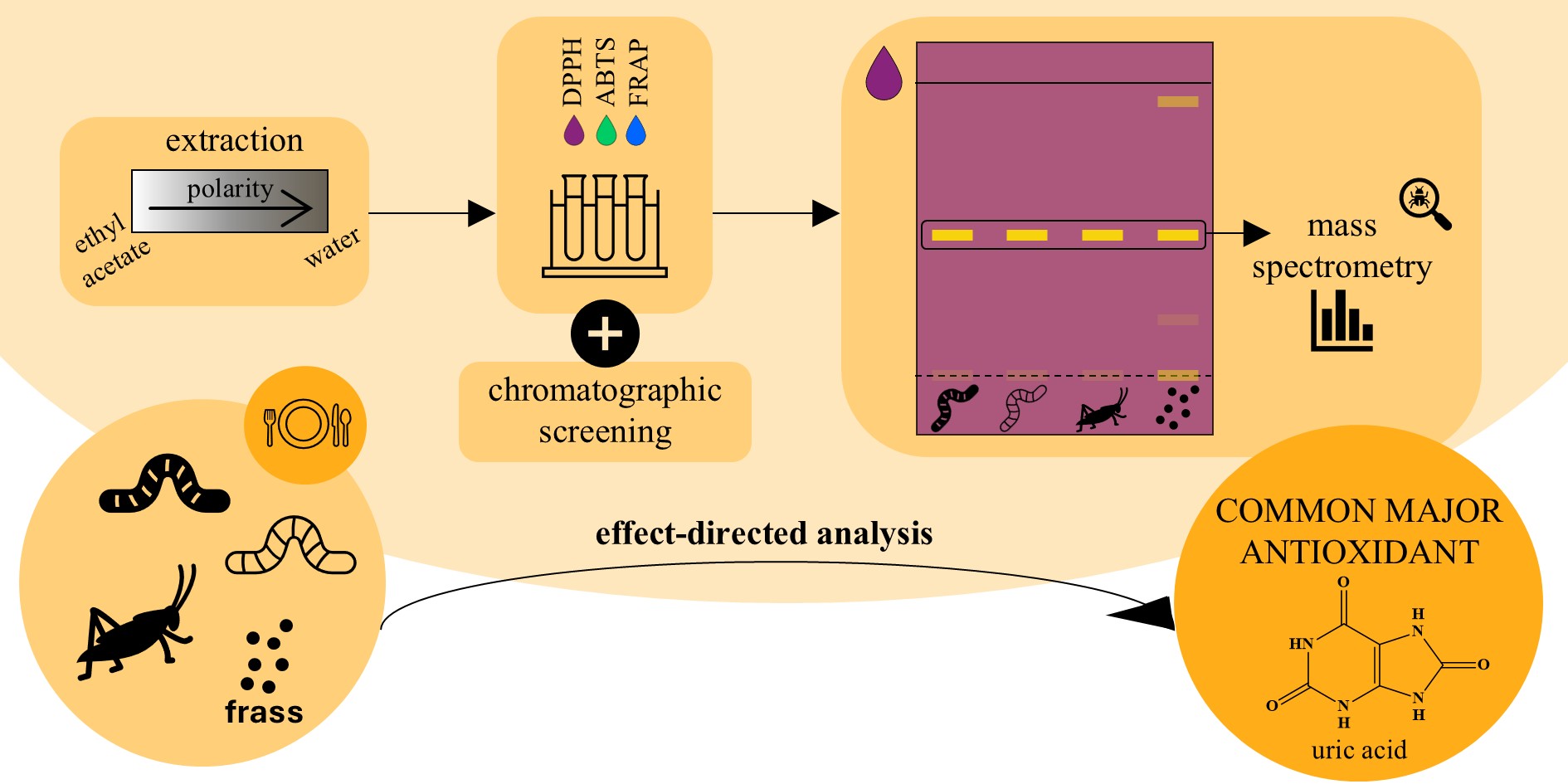
Researchers from the Laboratory for Food Chemistry at the Department of Analytical Chemistry published a study in Food Chemistry investigating the compounds contributing to the antioxidant capacity of edible insects. They identified uric acid as an important antioxidant in the polar extracts of all studied insect samples, as well as in the polar extracts of the analyzed frass sample.
The researchers began by applying established spectrophotometric antioxidant capacity assays, which are already commonly used in edible insect research. While these assays determine the overall antioxidant capacity of the extract, they do not reveal which compounds caused the measured antioxidant capacity. The interpretation of such results is often based on findings from plant research, leading to the assumption that edible insects are rich sources of antioxidants commonly found in plants. To investigate this further, the researchers first conducted chromatographic screening for several groups of known plant antioxidants, including phenolic compounds, but detected only a small number of these compounds in the extracts.
The few confirmed antioxidants did not intuitively explain the considerable antioxidant capacity of the insect extracts. To identify the actual contributors to the measured antioxidant capacity of the extracts, the researchers integrated the antioxidant capacity assays into the previously used chromatographic analyses. This approach enabled targeted identification of antioxidant compounds. They detected a prominent antioxidant signal that was present in all analyzed insect and frass samples and was the most intense among all antioxidant signals detected. Subsequent analyses confirmed that the compound behind the signal was uric acid.
The study advances our understanding of the antioxidant profile in edible insects, an important group of novel foods. Furthermore, it highlights the limitations of current analytical approaches in this field and emphasizes the importance of investigating antioxidant capacity at the level of individual compounds. Further research is warranted to investigate the bioaccessibility of antioxidants in insects and their subsequent fate after consumption.
Link to article: https://www.sciencedirect.com/science/article/pii/S030881462602621X#s0010
Contact: Eva Korenčič, eva.korencic@ki.si