

Which nickel surface species really catalyze the hydrogen evolution reaction? New study resolves a long-standing question.
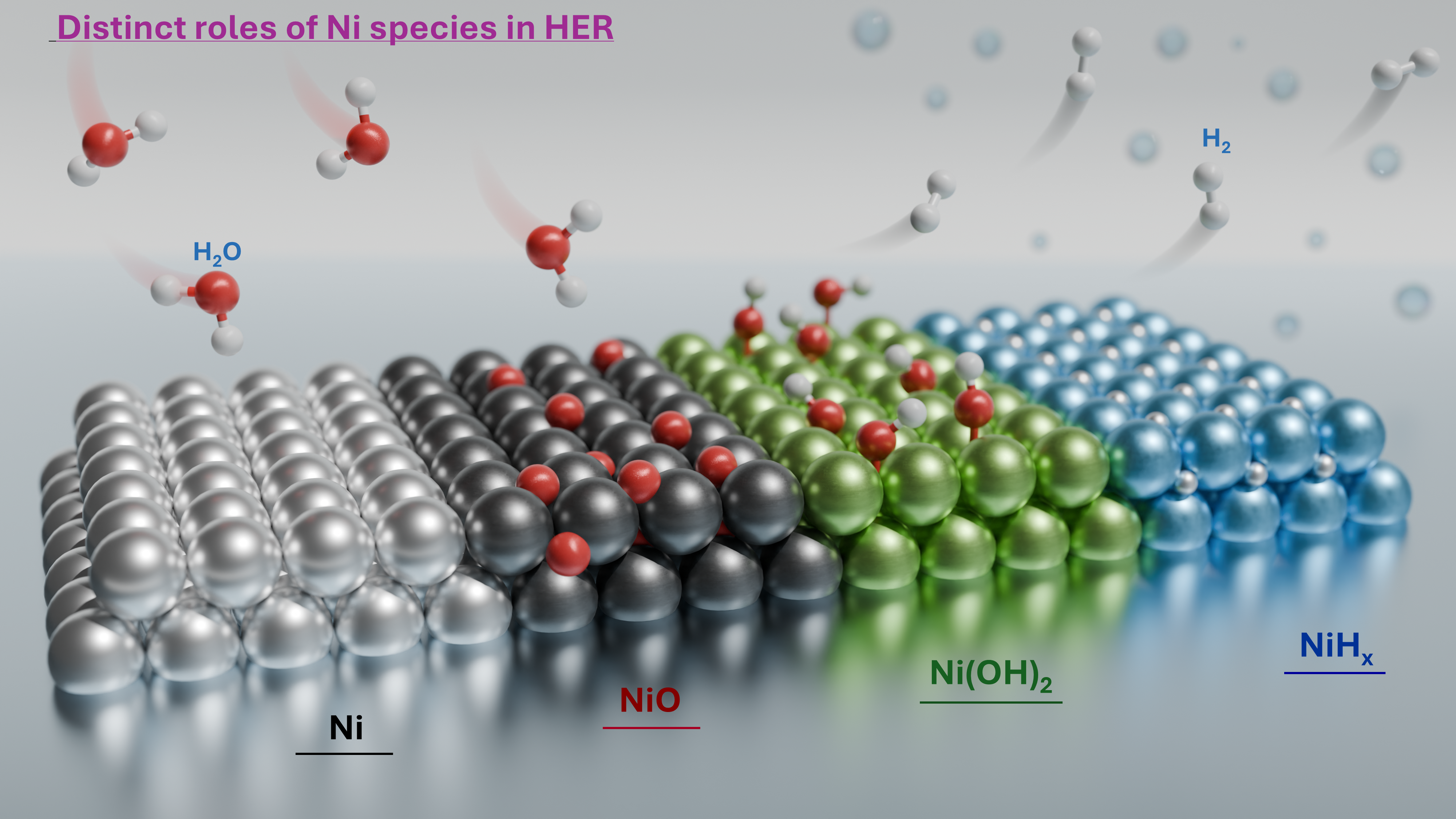
Researchers led by the National Institute of Chemistry have identified how different chemical species present on nickel influence hydrogen production in alkaline water electrolysers. The results, published in Nature Catalysis, provide a fundamental understanding of nickel-based catalysts and offer practical guidance for developing more efficient and durable electrolysers without relying on scarce precious metals.
Hydrogen produced by water electrolysis using renewable electricity could help decarbonise sectors that are difficult to electrify directly. Wider deployment, however, requires efficient and affordable electrolysers with long operating lifetimes. Alkaline water electrolysis is among the most established technologies for large-scale hydrogen production, and nickel is widely used as its cathode material because it is more abundant and less expensive than platinum-group metals.
Under operating conditions, nickel is not a single, uniform catalyst. Its surface can contain metallic nickel, nickel oxide, nickel hydroxide and subsurface nickel hydride, whose individual roles have remained controversial. By preparing well-defined surfaces and combining electrochemical measurements, surface characterisation and density functional theory calculations, the researchers separated their contributions. Nickel hydroxide, Ni(OH)₂, promotes hydrogen evolution when present in an optimal amount in direct contact with metallic nickel, where it facilitates water dissociation. Nickel oxide, NiO, contrary to many previous interpretations, acts as a spectator that blocks active sites, while subsurface nickel hydride, NiHₓ, inhibits the reaction.
The results show that performance depends not only on catalyst composition but also on the identity, amount and distribution of species at the working surface. Future nickel catalysts should therefore stabilise the active Ni/Ni(OH)₂ interface while suppressing NiO and NiHₓ formation. These surface states could be controlled through catalyst design and electrolyser operating protocols, linking fundamental surface science with practical electrolysis.
The publication represents a central outcome of the research project J7-4636, “Fundamental understanding of the hydrogen evolution reaction for a new generation of nickel-based electrocatalysts in alkaline water and chlor-alkali electrolysis,” funded by the Slovenian Research and Innovation Agency (ARIS). The project brought together researchers from the National Institute of Chemistry, the University of Ljubljana, the University of Maribor, the University of Nova Gorica and the Jožef Stefan Institute.
Publication:
D. K. Kozlica et al., “The role of individual nickel surface species in the hydrogen evolution reaction on nickel in alkaline electrolytes,” Nature Catalysis (2026).
https://doi.org/10.1038/s41929-026-01605-9
Contact: Dr. Dušan Strmčnik, dusan.strmcnik@ki.si