

Not all forms of lutein are absorbed equally
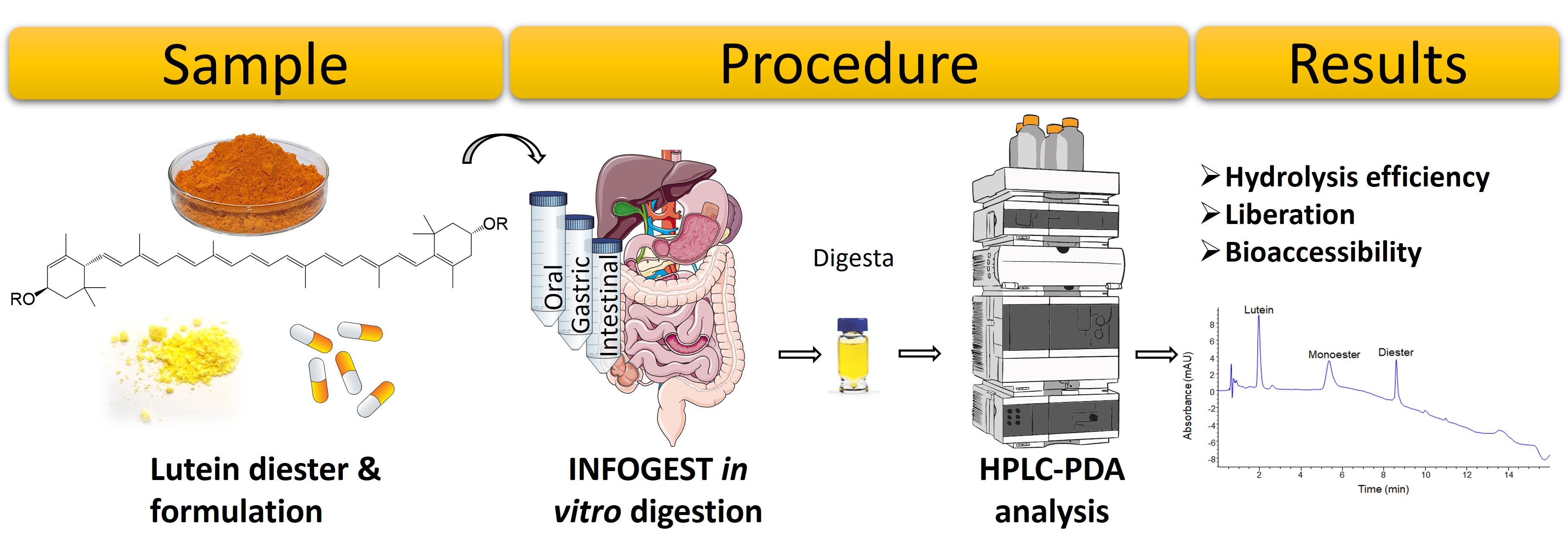
Researchers from the National Institute of Chemistry, in collaboration with the Faculty of Pharmacy at the University of Ljubljana and the Faculty of Chemistry at the University of Belgrade, have revealed how the chemical structure of lutein diesters influences their behaviour during digestion. In a study recently published in Food Chemistry, they showed that the length and branching of the attached fatty acids have a decisive effect on bioaccessibility—the proportion of lutein compounds incorporated into micelles after digestion and thus potentially available for uptake in the intestine.
Lutein is a natural yellow pigment and antioxidant that is particularly important for eye health. It is frequently used in dietary supplements in esterified form, yet it has remained unclear why individual forms behave so differently during digestion. The researchers therefore compared ten structurally distinct lutein diesters under controlled conditions. They used the standardised INFOGEST model, which simulates the oral, gastric and intestinal phases of human digestion. For the first time, the results systematically demonstrated that linear short-chain diesters had the highest bioaccessibility, ranging from 6.7 to 18.9%. Surprisingly, branched short-chain derivatives achieved comparable values despite being considerably more resistant to enzymatic hydrolysis. In contrast, long-chain diesters, which are common in commercial lutein supplements, showed poor incorporation into micelles and bioaccessibility below 3%.
The development of more effective products must therefore consider not only the chemical stability of lutein, but also its release and transfer during digestion. Lutein di(2,2-dimethylpropanoate) proved particularly promising, combining high chemical stability with relatively good bioaccessibility. The researchers prepared two model formulations of this compound and found that the liquid sunflower oil formulation performed better than the solid formulation based on a porous carrier: it provided greater protection of the pigment and enabled higher bioaccessibility.
The study is the result of international collaboration between Slovenian and Serbian research groups and provides new criteria for designing functional foods and dietary supplements containing lutein. The findings support further evaluation of selected short-chain and branched diesters in cellular models, in vivo studies and clinical trials, alongside an assessment of regulatory requirements for novel foods.
Link to article: https://www.sciencedirect.com/science/article/pii/S0308814626007302
Contact: dr. Alen Albreht, alen.albreht(at)ki.si