

When Less Is More: Mild Milling Leads to a More Efficient Photocatalyst
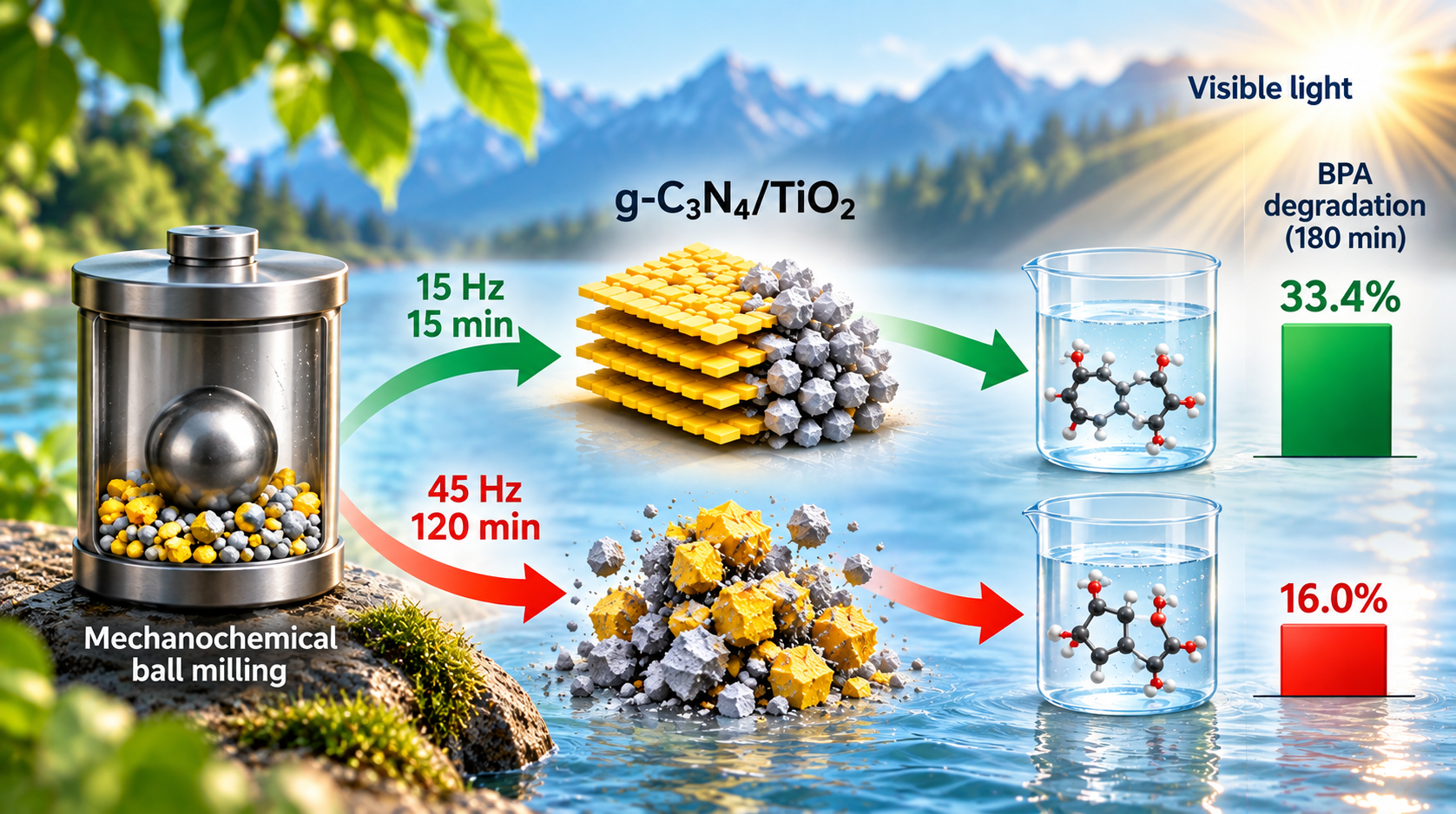
Researchers from the Laboratory for Catalysis at the Department of Inorganic Chemistry and Technology, National Institute of Chemistry, in collaboration with colleagues from the Faculty of Chemistry and Chemical Engineering, University of Maribor, and the Jožef Stefan Institute, have demonstrated that mechanochemical milling can be used to efficiently engineer graphitic carbon nitride (g-C3N4)/titanium dioxide (TiO2) heterojunctions. The study, published in Chemical Engineering Journal, reveals that more intensive milling does not necessarily produce a better material - the key lies in applying the appropriate degree of mechanical treatment.
Mechanochemical synthesis enables materials to be prepared using mechanical energy, potentially avoiding prolonged thermal treatments and the use of large quantities of solvents. In this study, the researchers systematically varied the frequency and duration of ball milling and investigated how these parameters affect the structural, electronic, and photocatalytic properties of g-C3N4/TiO2 heterojunctions.
The best results were obtained using mild milling at 15 Hz for only 15 minutes. These conditions preserved the structure and porosity of the material while establishing effective contact between the two semiconductors. The resulting material exhibited improved separation and transport of photogenerated charge carriers together with enhanced formation of reactive oxygen species. In contrast, prolonged high-intensity milling caused fragmentation, partial amorphisation, structural defects, and loss of porosity, ultimately impairing charge transport.
These differences were directly reflected in the photocatalytic removal of bisphenol A (BPA) from water under visible-light irradiation. After 180 minutes, the optimally prepared material achieved 33.4% BPA degradation and 14.4% total organic carbon removal, whereas the material subjected to the most severe milling conditions achieved only 16.0% BPA degradation. The findings demonstrate that successful mechanochemical engineering of semiconductor heterojunctions depends not on maximizing mechanical treatment, but on achieving the right balance between efficient interfacial coupling and preservation of the structural and electronic properties of the individual components.
Article:
Žerjav, G.; Roškarič, M.; Finšgar, M.; Zavašnik, J.; Pintar, A. Mechanochemical engineering of g-C3N4/TiO2 photocatalysts for optimized interfacial coupling. Chemical Engineering Journal, 2026, 182139. DOI: 10.1016/j.cej.2026.182139.
Article in Chemical Engineering Journal / ScienceDirect
Contact: Gregor Žerjav (gregor.zerjav(at)ki.si)