

Modulation of stability of building modules for designed bionanostructures
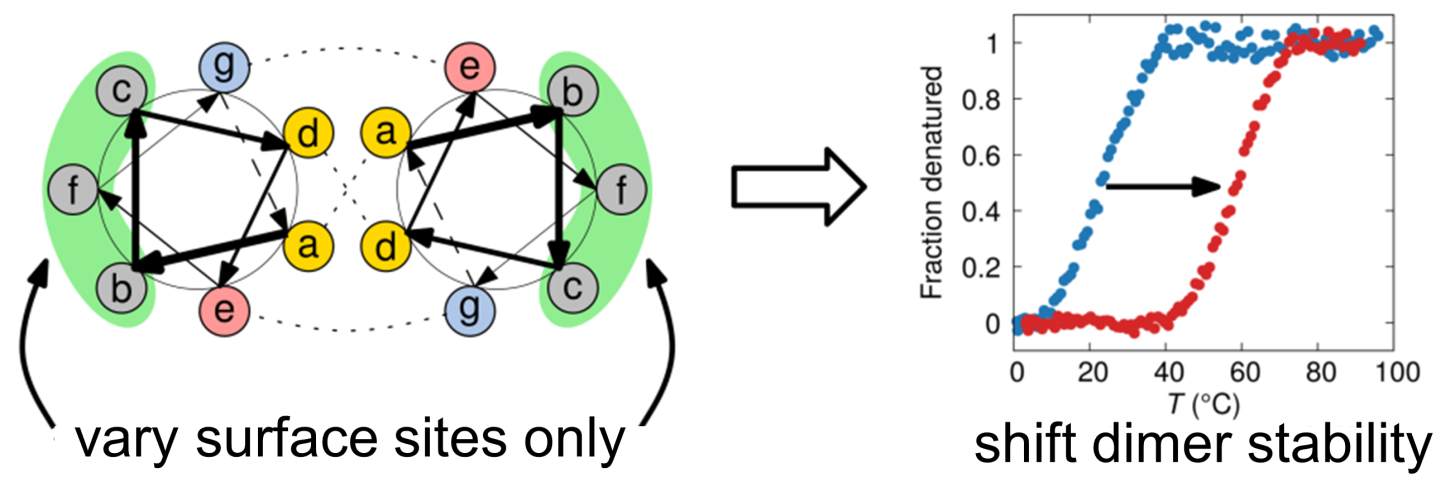
The coiled-coil dimer is a widespread protein structural motif and, due to its designability, represents an attractive building block for assembling modular nanostructures, which we demonstrated in 2013 in a paper in Nat.Chem.Biol. The specificity of coiled-coil dimer pairing is based on hydrophobic and electrostatic interactions. We showed how design of the local helical propensity of interacting peptides can be used to tune the stabilities of coiled-coil dimers over a wide range. This general principle was demonstrated by a change in thermal stability by more than 30 °C as a result of only two mutations outside the binding interface. Our findings enable a diverse range of applications in synthetic biology and nanomaterials. This study by authors Igor Drobnak, Helena Gradišar, Ajasja Ljubetič, Estera Merljak and Roman Jerala was published in the paper “Modulation of Coiled-Coil Dimer Stability through Surface Residues while Preserving Pairing Specificity” in the Journal of the American Chemical Society http://pubs.acs.org/doi/abs/10.1021/jacs.7b01690