

Mucoadhesive films with slow release for the delivery of vaccines for protection against respiratory diseases
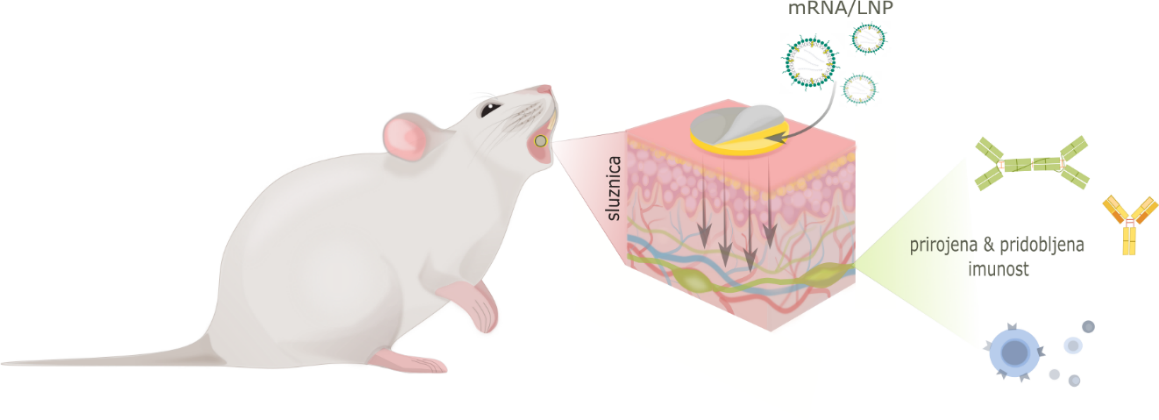
Vaccination is a safe and effective measure to protect against many infectious diseases. In the field of vaccines, tremendous progress has been made in recent decades, especially in the areas of antigen selection and technologies such as mRNA, which can be quickly adapted for different pathogens. In addition to vaccination by injection, the so-called mucosal vaccines, which are applied to the mucous membranes through which many pathogens enter the body. Mucosal vaccines mimic natural infection by stimulating both innate and acquired immune responses. Unlike injection, which requires trained medical personnel and often triggers fear of vaccination, transmucosal delivery is available in the form of more patient-friendly tablets, sprays or patches.
Researchers from the National Institute of Chemistry, with colleagues from the Faculty of Pharmacy UL, UKC, Golnik Clinic, and colleagues from Germany have developed and tested the delivery of vaccines using mucoadhesive films (MAF). The film easily sticks to the buccal mucosa, which is easily accessible and well supplied with blood. Due to its accessibility and abundance of immune cells, which are key to triggering the innate and acquired immune response, the buccal mucosa has great potential for vaccination. The film consists of two layers; of impermeable cellulose, which allows for targeted release, so that the layer of food-safe ingredients slowly dissolves and swells, and the vaccine from the film passes through the mucosal surface to the cells of the immune system, where it triggers an immune response. Such delivery exhibits significant advantages, such as efficient delivery to the tissue representing the first contact with pathogens, increased vaccine stability, and noninvasive administration.
Importantly, researchers have shown that this method can also deliver modern vaccines based on mRNA in lipid nanoparticles, which have proven to be the best against Covid19. The mRNA/LNP vaccines remained stable for several days and retained activity in the MAF form. The platform is also suitable for the delivery of other types of vaccines, including plasmid DNA and vector vaccines. In the article, they demonstrated that this method of vaccine delivery elicits a strong local and systemic immune response in mice. Of key importance is the increased secretion of secretory IgA antibodies, which play an important role in neutralizing pathogens on the surface of the respiratory tract where they enter the body. They showed that vaccination via the oral mucosa is also suitable for booster doses, as it strengthens the immune response created by intramuscular vaccination, and the results were also better than via intranasal administration. Vaccines using MAF delivery could be particularly suitable for booster doses as they are less invasive and may be able to convince those who have hesitated due to injection discomfort.
We can expect that this method of vaccination would provide effective protection against respiratory diseases. Especially with respiratory diseases such as COVID-19, it is desirable to achieve stronger mucosal immunity. In this way, we could prevent infection in the early stages and reduce the possibility of the disease spreading. Of course, it will be necessary to verify the results on models that are more similar to humans, and above all in clinical research, before this method of vaccine delivery could become established.
An article about this technology was published in the Journal of Controlled Release, with PhD students Hana Esih and Klemen Mezgec as first authors: https://www.sciencedirect.com/science/article/pii/S0168365924003262

Part of the authors of the research from the Department of Synthetic Biology and Immunology: Hana Esih, Roman Jerala, Klemen Mezgec (in the first row) and Špela Malenšek, Duško Lainšček and Mojca Benčina (in the second row, from left).