

Multiscale modelling discovers new catalysts and reveals reaction pathways

The increase in available computing power and improvement of the methods for theoretical description of matter have helped multiscale modelling become an indispensable method in chemical engineering and heterogeneous catalysis. It offers (a) detailed insight into the reaction beyond the reach of experimental methods, and (b) the possibility for the predictions and intelligent design of better catalysts and reactors.
In multiscale modelling, we describe chemical reactions on multiple scales: (1) using fundamental quantum chemical approach (DFT – density functional theory) the individual elementary reaction steps and the surface of catalysts, (2) on a mesoscale the evolution of the system on the catalyst surface (KMC – kinetic Monte Carlo), (3) with a mathematical microkinetic model the mass transport and heat transfer, the effect of pressure on solubility, and (4) the process in realistic reactors and deviations from ideality, for instance surface velocities, regions of poor mixing (CFD – computational fluid dynamics). While the individual methods are relatively well developed, their integration and coupling present a huge challenge, which researchers from the Department of Catalysis and Chemical Reaction Engineering (D13) are studying.
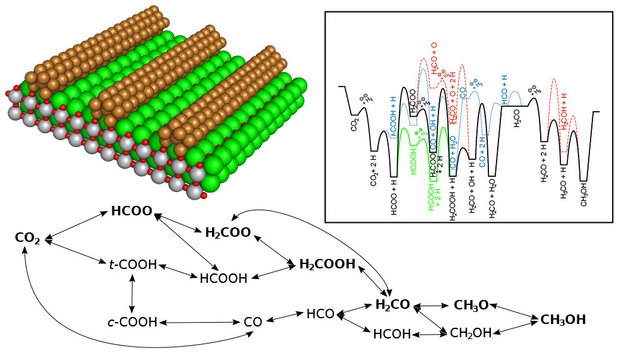
Predicting. Researchers from D13 used this methodology to describe the mechanism of hydrogenation of a greenhouse gas CO2 into methanol, thereby theoretically supporting and explaining the experimental work, which is also being conducted at the department. Conversion of carbon dioxide into methanol is an important reaction, which enables us to use surplus CO2 and convert it into a useful chemical and green fuel – methanol. Using multiscale modelling, a great potential of perovskite catalysts with strontium and copper was hinted at. The catalysts were later successfully synthesised and their performance confirmed. The paper describing the results was published in a leading journal in the field of catalysis ACS Catalysis (IF=11.4). DOI: 10.1021/acscatal.8b03810
Matej Huš, Drejc Kopač, Blaž Likozar. Catalytic Hydrogenation of Carbon Dioxide to Methanol: Synergistic Effect of Bifunctional Cu/Perovskite Catalysts. ACS Catalysis. 9, 105-116 (2019).
Explaining. Reactions can proceed differently on catalysts with the same chemical composition, if prepared in a different fashion. Researchers from D13 have in collaboration with colleagues from Chalmers University of Technology in Gothenburg, Sweden showed how and why different silver facets – Ag(111), Ag(110), Ag(100) – exhibit markedly different activity in ethylene epoxidation. After explaining the mechanism of the reaction, it was shown that the modelling results match experimental data. It was shown that the Ag(100) surface gets strongly oxidised and is highly selective, while the more stable surfaces Ag(111) and Ag(110) get less oxidised and are not suitable for this reaction on the account of their low selectivity. The paper with these results was published in ACS Catalysis (IF=11.4). DOI: 10.1021/acscatal.8b04512
Matej Huš, Anders Hellman. Ethylene Epoxidation on Ag(100), Ag(110), and Ag(111): A Joint Ab Initio and Kinetic Monte Carlo Study and Comparison with Experiments. ACS Catalysis. 9, 1183-1196 (2019).