

Multiscale simulations of exon-ligation in the spliceosome
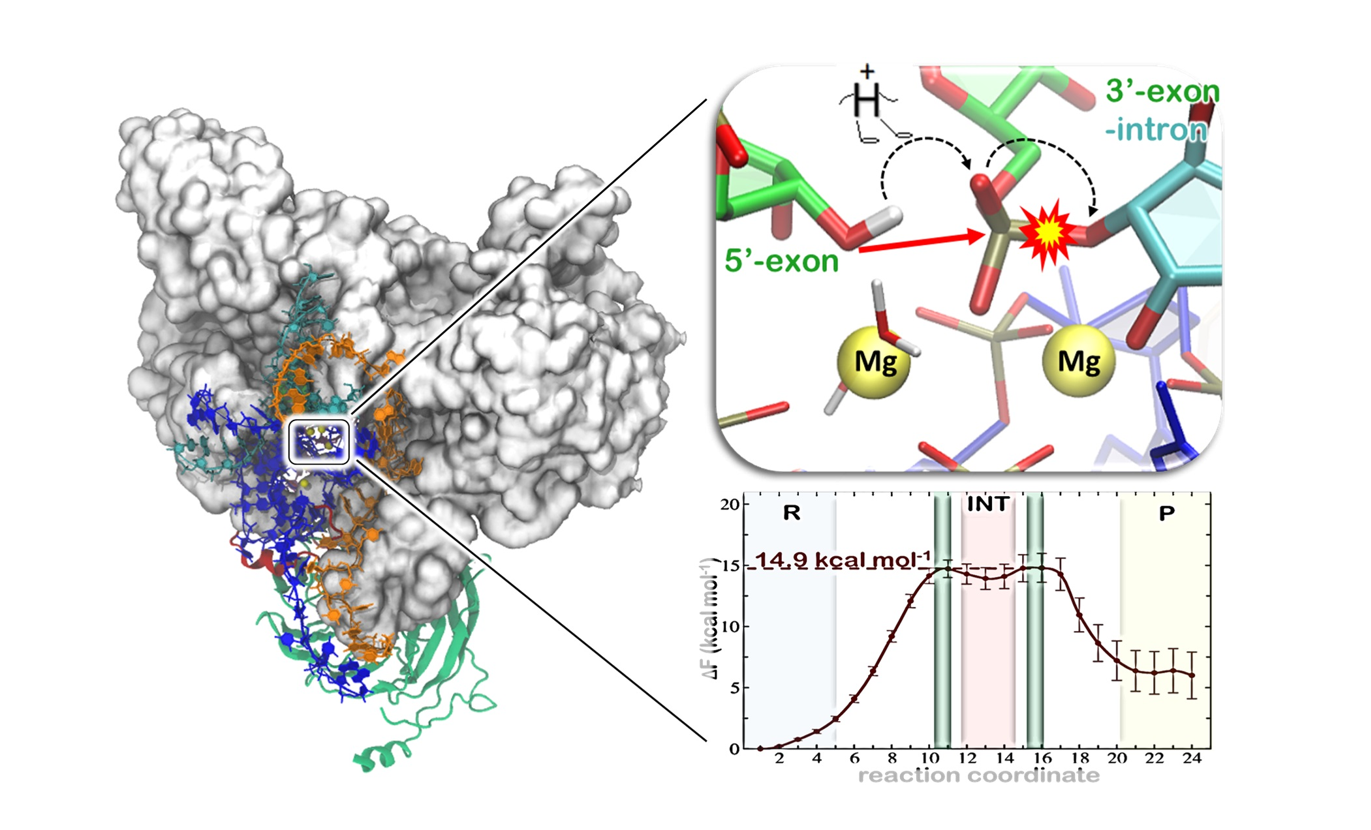
Ljubljana, April 20, 2020 - After decades of research efforts, the spliceosome (SPL) biology is undergoing a revolutionary phase due to increasing number of the cryo‐electron microscopy structures at near-atomistic resolution from yeast and human SPL that have appeared in the last few years. The presence of non‐coding sequences (introns) in nascent RNA transcripts is a hallmark of the genomes of all organisms. Introns have to be removed before protein translation occurs. The SPL, a macromolecular machinery composed of 5 small nuclear RNAs and hundreds of proteins, carries out intron removal (i.e. splicing) in eukaryotes. SPL catalyzes splicing in two subsequent reactions, mediated by two Mg2+ ions, undergoing a series of compositional and conformational changes.
By employing quantum-classical (QM/MM) molecular dynamics (MD) simulations along with thermodynamic integration, we addressed the second catalytic (exon-ligation) step, which occurs via an associative two-Mg2+-ion mechanism, exclusively catalyzed by RNA, with the scissile phosphate mediating a proton transfer from the nucleophile to the leaving group. Our outcomes provide fundamental advances in understanding the splicing mechanism in eukaryotes disclosing how the catalytic core of spliceosome’s ancestors self-splicing ribozymes remained conserved during evolution.
Understanding the mechanism of splicing is of utmost microbiological, biotechnological, and pharmacological importance. Indeed, aberrant splicing is associated to numerous complex diseases, such as cancer and neurodegeneration.
This article was published in ACS Catalysis, the authors of the research are Dr. Jure Borišek from National Institute of Chemistry (D01, Laboratory for Cheminformatics) and Prof. Dr. Alessandra Magistrato (CNR-IOM, Italy).
Link: doi.org/10.1021/acscatal.0c00390
For further information please contact: jure.borisek[at]ki.si