Nanoshaped CuO/CeO2 materials: Effect of the exposed ceria surfaces on catalytic activity in N2O decomposition reaction

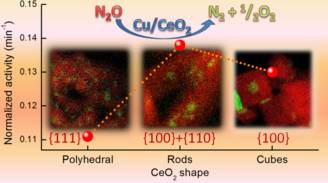
Researchers from the Laboratory for Environmental Sciences and Engineering (Maxim Zabilskiy, Dr. Petar Djinović and Prof. Dr. Albin Pintar) and Laboratory for Materials Chemistry (Dr. Elena Tchernychova) have in collaboration with Dr. Olga P. Tkachenko and Prof. Dr. Leonid M. Kustov (Zelinsky Institute of Organic Chemistry, Moscow) investigated the effect of terminating CeO2 crystalline planes ({100}, {110} and {111}) on catalytic activity of CuO, dispersed over CeO2 nanocubes, nanorods and polyhedral crystallites. Oxygen mobility and regeneration of active Cu phase that significantly influence the kinetics of catalytic N2O decomposition, is easier on {100} and {110} surface planes. This in turn facilitates higher catalytic activity through the recombination of surface oxygen atoms and their desorption from the catalyst surface in the form of molecular oxygen, which replenishes active sites for subsequent catalytic cycles. As a consequence, CuO supported on CeO2 nanorods demonstrated lower activation energy (87 kJ/mol) in N2O decomposition reaction compared to CeO2 nanocubes (102 kJ/mol) or polyhedral CeO2 (92 kJ/mol). CeO2 morphology in catalysts employed in the process of N2O decomposition, needs to be tailored to expose {100} and {110} high-energy surface planes, as present in CeO2 nanorods.
Results of this research are published in a prestigious journal ACS Catalysis (Zabilskiy et al., ACS Catalysis, doi: 10.1021/acscatal.5b01044).