

National Institute of Chemistry in the year 2019

Ljubljana, 10. 01. 2020 - Two prestigious European Research Council (ERC) projects acquired, a high-profile scientific publication in the most prominent scientific journals, enrichment of research infrastructures, recognition of our researchers for innovation, a number of achievements in applications to European projects, excellent integration in the Slovenian industrial environment, and successful cooperation with some foreign companies – all this shows that the year 2019 was very successful for the Chemical Institute. In the following, we present some of the most important achievements of the previous year.
Two new ERC research projects acquired
One of the most important achievements of the year 2019 is undoubtedly the acquisition of two prestigious European Research Council (ERC) projects:
1. The ERC Advanced Grant project, titled 'RNP Dynamics', obtained by Prof. Dr. Jernej Ule, professor of Molecular neuroscience at University College London (UCL). He will be researching how the regulation of RNA molecules contributes to the development and functioning of the brain, and how errors in such regulation lead to neurodegenerative diseases such as amyotrophic lateral sclerosis (ALS). The studies will be based on techniques which accompany the entire cellular networks of molecular contacts, which will generate a large amount of data. Such data will then serve as the basis for computer analyses looking for changes in molecular contacts, which are key for the dynamics of molecular complexes, and thus lead to the early development of the brain. The project will also study how errors in contacts between proteins and RNA damage the functioning of the neurons and thus trigger ALS disease. This will serve as the basis for the development of new strategies to find a cure for the disease using RNA molecules.
More: www.ki.si/novice/single-prikaz/novice/novica/prof-dr-jernej-ule-prejel-erc-advanced-grant-2018/
2. The ERC Starting Grant project, titled '123STABLE', obtained by associate Prof. Dr. Nejc Hodnik, researcher at the Chemistry Institute, Department of Catalysis and Reaction Engineering. He will explore how the atomic structure of electrocatalyst nanoparticles changes when operating in low-temperature fuel cells and electrolysers. The knowledge gained will be the basis for the design of new stable structures of catalyst nanoparticles. This will in turn lead to the development of better and more advanced catalysts, which is an important contribution to the development of the hydrogen economy.
 Recipients of ERC projects: Prof. Dr. Jernej Ule (on the left) and associate Prof. Dr. Nejc Hodnik (on the right)
Improvement of research equipment
The year 2019 was also very successful in the area of investment in research infrastructure. Among the more important new acquisitions, we present the following:
1. Opening of the Ažman Computer Centre
With the latest update of the computer cluster in the context of the Ažman Computer Centre, we now have superior computer equipment for the performance of high-performance (HPC) numerical calculations and computer simulations. The above-mentioned upgrade has more than doubled the capabilities of the equipment we had before. The new cluster is based on AMD EPYC processors, which currently represent the most advanced microprocessor architecture.
More: www.ki.si/novice/single-prikaz/novice/novica/odprli-smo-azmanov-racunski-center-arc/

The Ažman Computer Centre is named after Prof. Dr. Andrej Ažman, a pioneer of computer quantum chemistry in Slovenia.
2. The inauguration of the cryo-electronic microscope
The new cryo-electronic microscope, installed at the Chemistry Institute, is an extremely important research device that will greatly raise the quality of research, and in this way, enrich the scientific space in Slovenia and the wider region, and also allow for superior development research in Slovenian industry. Cryo-electronic microscopy is one of the methods used in structural biology for the determination of three-dimensional molecular system structures, where measurements take place in the cryogenic temperature area, i.e. approximately at –180 ºC. The key advantage of cryo-electronic microscopy, in comparison to other technical approaches, is that it allows the structure of molecules to be set in a very wide area and in a natural form.
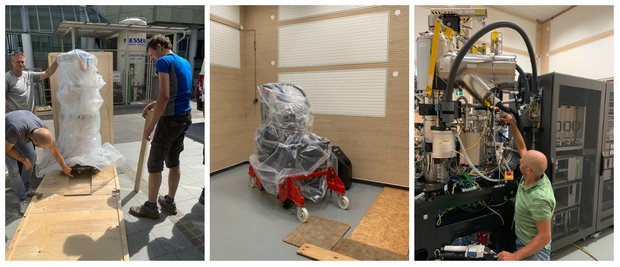
Installation of a new cryo-electron microscope.
3. Inauguration of the new 600 MHz NMR spectrometer
The purchase and launch of a new 600 MHz NMR spectrometer is an important step in the effort to provide capabilities that are comparable to those in related research centres around the world. The 600 MHz NMR spectrometer, with its high resolution and sensitivity, enables the study of the spatial structure and dynamics of complex systems with a high molecular mass, such as proteins and nucleic acid in a solution. The new 600 MHz NMR spectrometer is an important acquisition for the research work of the wide range of researchers who perform their project activities using NMR spectroscopy. This allows the implementation of multi-dimensional and multinuclear experiments that allow for insight into structural details of atomic resolution molecules.
More: www.ki.si/novice/single-prikaz/novice/novica/inavguracija-novega-600-mhz-nmr-spektrometra/
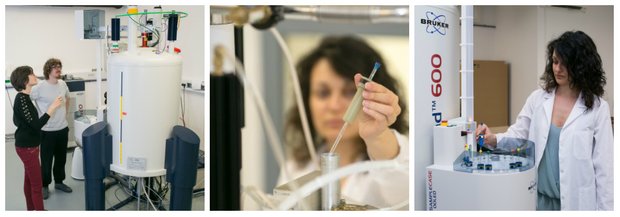 The new 600 MHz NMR spectrometer.
4. New laboratory for battery testing
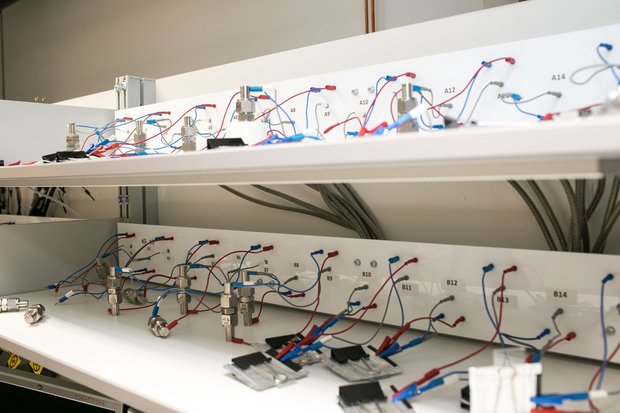
The laboratory for battery testing, which operates within the material chemistry department, allows the testing of battery cells of different sizes. It is primarily intended for the development of modern battery materials, which is one of the directions of the department. The available equipment currently occupies a good half of the laboratory, which allows for further expansion, and thus the possibility of further consolidation of the Chemical Institute, in the Slovenian and international space, as a leading research institution in the field of development and understanding of modern battery systems. The new laboratory also has equipment that enables collaboration with domestic industry and industry from neighbouring regions. At the same time, the laboratory provides the ability to test and use the knowledge available at the department.
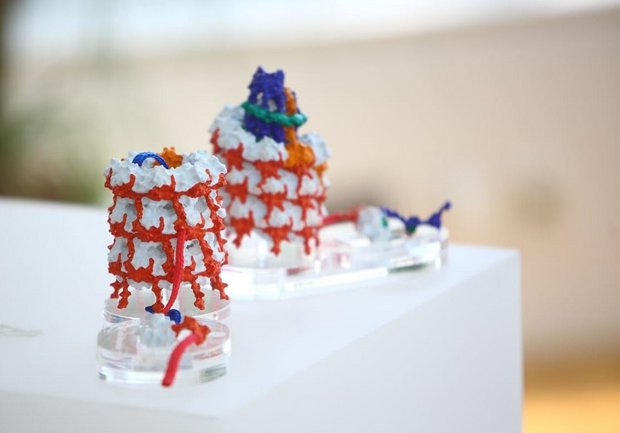
The first identified three-dimensional structure of potato virus Y
One of the more significant scientific achievements of the previous year was made by a team of Slovenian researchers under the guidance of scientists from the Chemical Institute, which was the first to be able to establish a three-dimensional structure of potato virus Y, and a high-resolution structure of a virus-like particle, by using the cryo-electronic microscope. They were the first to show that the architecture of the viral threads and the threads of the virus-like particle, differ considerably. This realisation represents a great contribution to understanding the biology of such an important plant virus. The structural and functional research of the regions of the Y potato virus mantle has shown its crucial role in viral infection, which can allow for more effective planning of strategies for the protection of cultural plants in the future. The achievement is published in the prestigious magazine, Science Advances.
More: www.ki.si/novice/single-prikaz/breaking/novica/objava-raziskovalnega-dela-v-reviji-science-advances/
Success in cooperation with industry
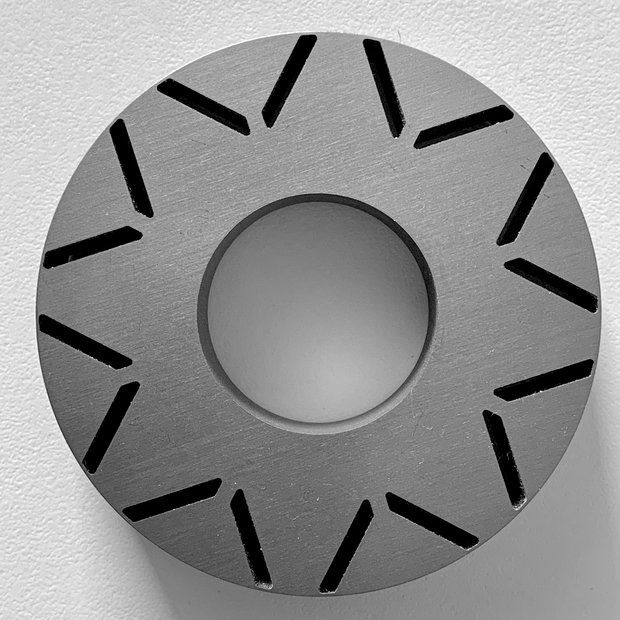
In the past year, we were also successful in our cooperation with industry partners. As an exceptional example of a quick solution to a technological problem, we should highlight the cooperation with Hidria. Experts from the Chemical Institute participated in the development of a brand new, innovative technology for the bonding of stator and rotor package lamellas. Hidria Bond, as this new solution is called, is a unique technological process that enables efficient and competitive production of parts for top-notch high-performance electric motors. The process represents a major innovative leap in the way of producing key parts of electric motors, and allows Hidria to break into global markets. Lastly, this is a major contribution to the affordability of electromobility.
More: https://www.hidria.com/int/sl/novice/hidria-bond-nam-odpira-nove-posle-v-elektromobilnosti/
Innovation awards
The year 2019 has also brought many awards to our researchers, the most notable being:
1. At the ceremony of the University of Ljubljana's awards for pervasive technological and non-technological innovations, the first place was awarded to the innovative process of preparing catalysts for better and cheaper hydrogen fuel cells. The innovative process was designed by a young researcher from the department of material chemistry, Matija Gatalo.
More: www.ki.si/novice/single-prikaz/novice/novica/glavna-rektorjeva-nagrada-pripadla-inovaciji-s-kemijskega-instituta/
2. At MOS in Celje, we received a Gold award for the innovation of the young researcher, Matija Gatalo - the nanotechnological process of preparing catalysts for better and cheaper hydrogen fuel cells.
More: www.ki.si/novice/single-prikaz/novice/novica/zlato-priznanje-za-inovacijo-kemijskega-instituta-52-mos-celje/
3. The team at the material chemistry department received a silver GZS recognition in the field of innovation, for the innovation of "sustainable non-combustible polyamide 6 fibres".
More: www.ki.si/novice/single-prikaz/novice/novica/priznanje-za-inovacijo-v-osrednjeslovenski-regiji/
4. At "The biennial European Meeting on Fire Retardant Polymeric Materials" in Finland, Dr. Marija Čolović, from the material chemistry department, received the first prize in the competition for the best poster. It presented our joint research work with the Faculty of Natural Sciences, University of Ljubljana: "Novel flame retardant polyamide 6 copolymer".