

(NatureX)3

The members of the Department of Synthetic Biology and Immunology have published three articles in the prestigious journals of the Nature family over the past month. This is an achievement which is also in the most important research groups in the world quite rare.
In the article authored by Dr. Iva Hafner Bratkovič and her coworkers, published in Nature Communications, researchers reveal the mechanisms of inflammation initiation through NLRP3 inflammasome activation.
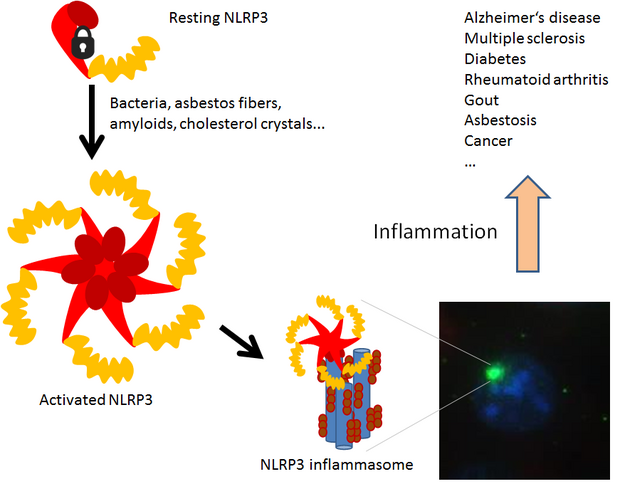
Inflammation is the response of our immune system to infection and harmful environmental effects. On one hand, it is beneficial as it defends our body against microbes. On the other hand, excessive inflammation leads to serious diseases. A recent research reveals details on inflammation initiation through engagement of protein called NLRP3. Researchers from National Institute of Chemistry, Slovenia together with their Spanish colleagues discovered that a large part of NLRP3 protein is dispensable for detection of danger. They also showed how NLRP3 is regulated. Tight regulation of NLRP3 that is in contrast to other innate immune safeguards triggered predominantly by self-derived molecules might be crucial for suppressing auto-inflammatory response. As NLRP3 is involved in a variety of devastating and incurable diseases such as Alzheimer’s disease the insight into NLRP3 activation provides the basis for development of novel therapies and diagnostics methods.
Reference: Iva Hafner-Bratkovič, Petra Sušjan, Duško Lainšček, Ana Tapia-Abellan, Kosta Cerović, Lucija Kadunc, Diego Angosto-Bazarra, Pablo Pelegrίn, Roman Jerala: NLRP3 lacking the leucine-rich repeat domain can be fully activated via the canonical inflammasome pathway. Nature Communications 2018, DOI: 10.1038/s41467-018-07573-4
Link to the full text of the paper: https://www.nature.com/articles/s41467-018-07573-4
In the article authored by Dr. Tina Lebar and her coworkers, published in Nature Chemical Biology, researchers explain the discovery of a new principle of gene regulation by molecular displacement by TALEs.
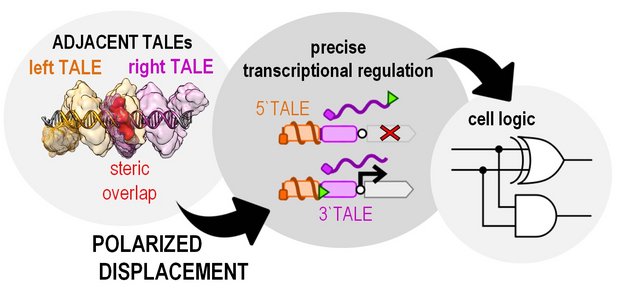
Activity of genes is defined by proteins that bind to the DNA in their close proximity. Transcription Activator-Like Effector (TALE) proteins can be designed to bind almost any selected DNA sequence. Researchers at the Department of Synthetic Biology and Immunology at NIC reported several years ago that TALEs can be used to introduce logic functions into mammalian cells. Now researchers from the same group report in an article in Nature Chemical Biology that TALE proteins can displace other TALE proteins from the DNA in a highly polarized manner –the displacement of a TALE can occur only by binding of another TALE protein to the DNA sequence adjacent to its left but not its right side. Based on a chained displacement of several adjacent TALE proteins, the researchers managed to implement all two-input logic circuits in human cells. This unusual property of TALEs has been used to increase the precision of regulation of gene expression, for design of logic circuits in mammalian cells and to prevent CRISPR-mediated cleavage at non-desired DNA sites. Researchers believe that the discovery is important both for understanding the mechanism of rearrangement of molecular complexes in nature, as well as for increasing the accuracy, safety and efficacy of cell therapy or for biotechnological use.
Reference: Tina Lebar, Anže Verbič, Ajasja Ljubetič, Roman Jerala: Polarized displacement by transcription activator-like effectors for regulatory circuits' Nature Chemical Biology 2018, available as an Advanced Online Publication DOI: 10.1038/s41589-018-0163-8
Link to the full text of the paper: https://www.nature.com/articles/s41589-018-0163-8
In the article authored by PhD student Tina Fink and her coworkers, published in Nature Chemical Biology, researchers reveal the increased speed of engineered human cell response. They have developed a novel, fast approach to regulate human cell response, endowing cells to respond to extracellular stimuli in minutes instead of hours. The authors believe that their system could be useful in various medical applications.
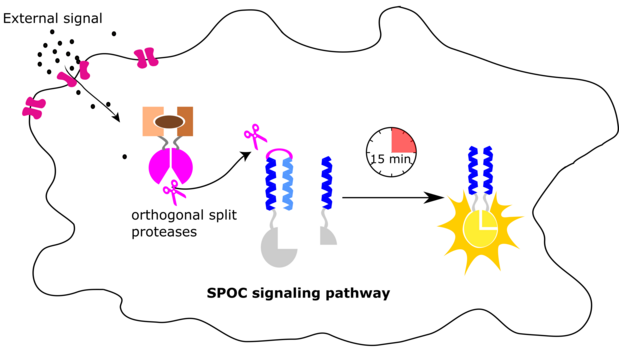
Even though we do not yet fully understand the inner workings of cells, we are able to modify cells to allow them to respond to specific extracellular signals, which is a crucial feature for the use of cells in therapeutic applications. The implementation of novel control systems inside cells is an important goal of synthetic biology. Although scientist have been able to successfully implement artificial regulatory systems inside cells, the speed of response these systems was slow and therefore posed an important limitation. Researchers from the National Institute of Chemistry in Slovenia have recently published an article in Nature Chemical Biology, which reports an innovation that allows for a much faster response than what was achievable before: they were able to detect the cells responding to the programmed input within minutes instead of hours. This was achieved by a careful design of interactions between proteins that can be cleaved into smaller fragments that led them to assemble into new complexes as a response to input signals. The researchers have thus found a way to bypass the slow process of gene regulation, but retained the ability to construct parallel and sequential information processing mechanisms like logic gates and cascades, comparable to an increase in computer processing speed by an order of magnitude. This discovery leads to the development of advanced cellular computers, and as the described mechanisms resemble natural processes such as e.g. blood coagulation, it could represent a valuable tool for the development of future medical and biotechnological applications.
Reference: Tina Fink, Jan Lonzarić, Arne Praznik, Tjaša Plaper, Estera Merljak, Katja Leben, Nina Jerala, Tina Lebar, Žiga Strmšek, Fabio Lapenta, Mojca Benčina in Roman Jerala: Design of fast proteolysis-based signaling and logic circuits in mammalian cells. v Nature Chemical Biology 2018, DOI: 10.1038/s41589-018-0181-6
Link to the full text of the paper: rdcu.be/bdbGi