New findings in crystal engineering of metal-organic framework materials

The understanding of crystallization mechanism is crucial for a rational design of new metal-organic (MOF) porous materials with desired properties for specific applications, like heat and gas storage, gas separations, drug delivery, catalysis, etc.
The detection the fundamental building blocks of growth and/or intermediate phases is thus of profound interest, but appears to be a great experimental challenge.
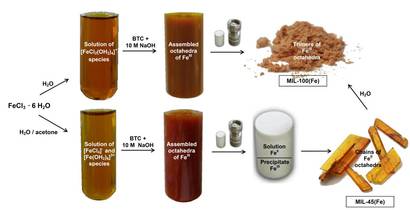
Researchers from the Laboratory for Inorganic Chemistry and Technology (L09) Tadeja Birsa Čelič, Mojca Rangus, Venčeslav Kaučič and Nataša Zabukovec Logar in collaboration with Károly Lázár (Centre for Energy Research, Institute of Isotopes, Budapest) studied the competitive formation of two porous iron carboxylates by using X-ray absorption (XAS) and Mössbauer spectroscopies. By detailed investigation of different stages of synthesis from solution to the formation of final crystalline products, they succeeded to demonstrate how the presence of aprotic solvent (acetone) changed the formation mechanism from the very first beginning of the synthesis (type and structure of primary building blocks, oxidation state of iron at elevated temperatures) if compared with pure water solution.
It is the first study that evaluates the role of the solvent in the MOF formation process by analyzing the local structure of species that are present in the precursor solution and gel.
The study is published in Angewandte Chemie International Edition (impact factor 13.5).