

New Ir-Ru electrocatalyst for sustainable water electrolysis
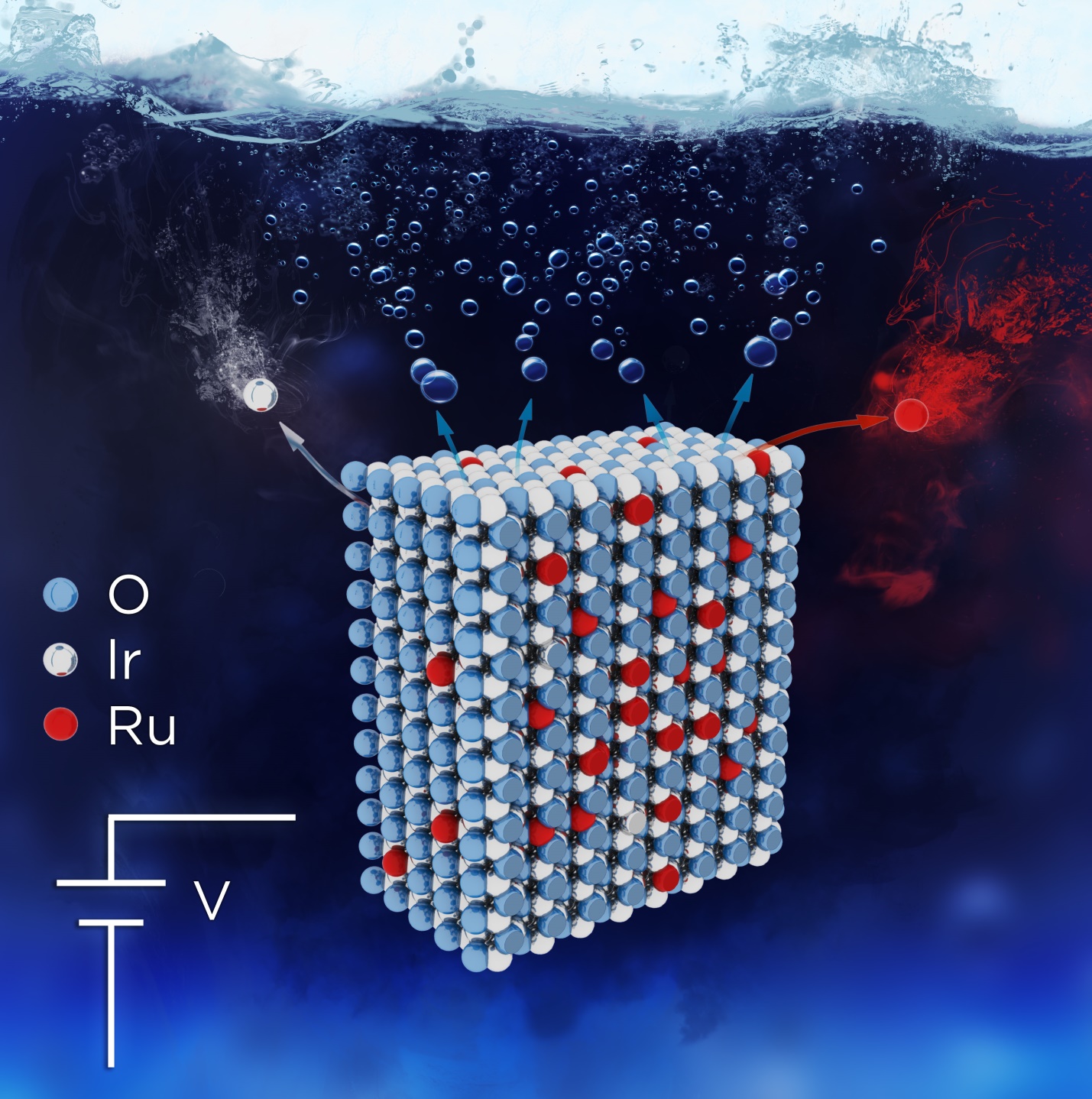
The transition to renewable energy sources through hydrogen technologies involves the electrolysis of water. Polymer electrolyte membrane (PEM) electrolysis represents a highly efficient, responsive, dynamic and convenient solution for storing large quantities of electricity in the form of hydrogen to cover the gap between the production of renewable energy (the sun and the wind) and the demand of the network at different time periods (day / night and summer / winter). Article introduces a new iridium-based catalyst and ruthenium for the reaction of oxygen evolution, which is an inevitable counter-reaction in the electrochemical formation of hydrogen. Membrane electrode assembly (MEA) test showed excellent activity, that is, high current density (3 A cm-2 at 1.8 V with> 80% enthalpy efficiency) at a low catalyst loading (0.34 mg cm-2).
Using our unique technique for on-line detection of the dissolved metals and our state-of-the-art transmission electron microscopy (TEM), we demonstrate that the key degradation mechanism is the removal of ruthenium and iridium from the crystal structure of nanoparticles. The work was a joint effort of three departments at National Institute of Chemistry (D04, D10 and D13) and the CNR - Institute for Advanced Energy Technologies "Nicola Giordano" of Messina, Italy.
Authors: Stefania Siracusano, Nejc Hodnik, Primoz Jovanovic, Francisco Ruiz-Zepeda, Martin Šala, Vincenzo Baglio, Antonino Salvatore Aricò
Journal: Nano Energy, http://www.elsevier.com/locate/issn/22112855
Article: http://www.sciencedirect.com/science/article/pii/S2211285517305529