New Na-ion cells to accelerate the European Energy Transition

Ljubljana, 16.01.2020 - The National Institute of Chemistry has acquired a new European project, NAIMA, in which it will participate as a partner in the development of new Na-ion batteries.
The European project NAIMA aims to develop a new generation of high-competitive and safe Na-ion cells for the current and future energy storage technologies, supported by the key actors of the European Battery value chain.
Last month the new EU funded project NAIMA “Na Ion materials as essential components to manufacture robust battery cells for non-automotive applications” was kickstarted in Amiens (France). This project was awarded a Horizon2020 programme grant of almost 8 M€ by the European Commission. The duration of the project will be 36 months as of 1 December 2019.
The NAIMA project will demonstrate that two new generations of highly-competitive and safe Na-ion cells developed and tested during the project are some of the most robust and cost-effective alternatives to unseat current and future Li-based technologies in dedicated storage applications, nowadays controlled by Asian industry. The Na-ion disruptive technology is already supported by a solid European Battery value chain (industry partners of the consortium) through their solid commitment of substantial investments in the manufacturing of all components of a battery, preserving the ownership and industry strength around European countries.
NAIMA bring together a strong and complementary consortium, including 15 partners from 8 European countries (France, Germany, Sweden, Bulgaria, Spain, Netherlands, Slovenia and Belgium): 5 being R&D organisation (CNRS, CEA, NIC, IHE, VITO), 6 SMEs (TIAMAT, BIOKOL, IEIT, GOLDLINE, ACC, ZABALA IC) and 4 large companies (EDF, GESTAMP, SOLVAY, UMICORE). The well-balanced and interdisciplinary profiles of the partners covers satisfactorily the entire battery value chain along with the diverse fundamentals R&D fields required in the project. Moreover, an international advisory board will be involved in the development of the project, so that the use cases developed become real business models.
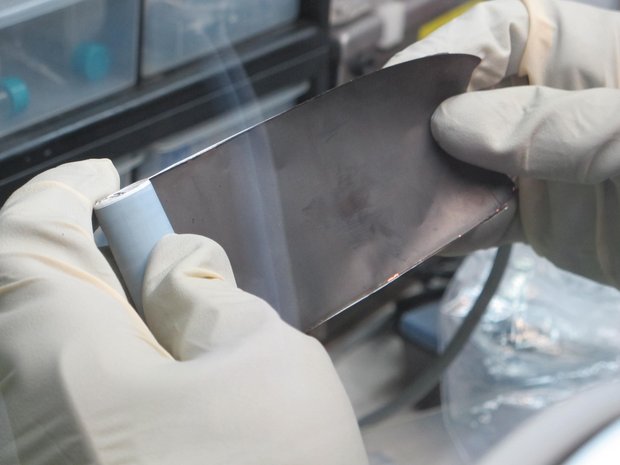
At The National Institute of Chemistry the project NAIMA will be leaded by Prof. Dr. Robert Dominko, Dr. Alen Vižintin and Ph.D. student Blaž Tratnik.
The project is led by the French company TIAMAT, which hosted the kick - off meeting in Amiens, and is specialized in the design, development and manufacture of sodium ion battery cells targeting fast charging.high discharge current applications in mobility and stationary storage sectors.
Within the framework of the project, 6 SIB prototypes will be tested in 3 multi-scale Business Scenarios to provide solid evidences about the competitiveness of the technology in 3 real environments (renewable generation – EDF/France, industry – GESTAMP/Spain and private household-GOLDLINE/Bulgaria).
To that end, the involvement of the end users (EDF, GESTAMP, GOLDLINE) will play a crucial role as strict “technology auditors” to assess the feasibly of becoming “potential buyers” of SIBs in their business ecosystems. Furthermore, the “sustainability approach” will be ensured by the definition of concrete 2nd life potential applications and the fullfilment of a high recycling efficiency rate (>50%wt). This approach will be reinforced by the development of a product integrated methodology capable to combine technical, environmental and social aspects in a full Life Cycle Assessment (LCA) and Life Cycle Costing (LCC).
“The NAIMA Project is the perfect opportunity to further develop a deep, fundamental and practical knowledge of Na-ion technologies in order to assess their potential in realistic environments and help bring them to a comercial reality. The possibility to source most of the materials of these batteries from within Europe fits well with the strategy and willingness of the European comission and would help de-risking some of the key challenges with the value chain of Li-ion cells. TIAMAT is very proud and excited to be working alongside the best industrials and labs in Europe to deliver Na-ion as an alternative energy storage technology.”
The context in the frame of Energy Transition
The EU is transitioning to a secure, sustainable and competitive energy system as laid out in the EC’s Energy Union strategy. The growing penetration of renewable energy sources in the EU energy market, go hand in hand with a high competitiveness of the most consolidated technologies: Wind Energy and Solar Photovoltaics. The non-dispatchable renewable generation requires a higher flexibility in the energy system, where the weight of much more decentralised installations grow day-to-day. In fact, the flourishing of a wide portfolio of renewable energy installations is allowing the deployment of large to small scale industrial electricity grids, and in an increased share of electricity produced in private households.
Just the availability of the raw materials of Li-ion cells is almost a “miracle”. Under this scenario, the most robust non-Lithium alternative is the technology based on Sodiumion (Na-ion). This disruptive technology is already supported by a solid European Battery value chain (industry partners of the consortium) through their solid commitment of substantial investments in the manufacturing of all components of a battery, preserving the ownership and industry strength around European countries.
More information: alen.vizintin(at)ki.si
This project has received funding from the European Union’s Horizon 2020 research and innovation programme under grant agreement No 875629.