New Perspectives in the Field of Electric Vehicle Batteries

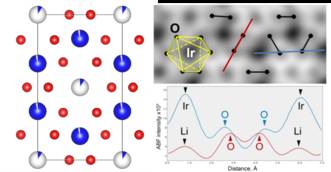
Visualisation of O-O peroxo-like dimers in high-capacity layered oxides for Li-ion batteries
This article is the result of cooperation between the Laboratory of Materials Chemistry at the National Institute of Chemistry and the College de France in Paris and is based on the joint postdoctoral research under the mentorship of Associate Professor Robert Dominko and Professor Jean-Marie Tarascon. The research brought together experts in materials synthesis, crystallography, microscopy and theoretical chemistry who disproved the belief that the energy density of battery materials is intrinsically limited by the number of electrons that can be reversibly incorporated into the electrochemical reaction. Based on the insights gained by using different characterisation techniques, they proved that in some cases the oxygen subnet in crystal structures could reversibly enter the electrochemical reaction. This considerably increases the total specific capacity and reversibly stored energy.
The basis for understanding this new phenomenon was research carried out using neutron and transmission spectroscopy supported by theoretical calculations.The article is the first publication of the National Institute of Chemistry in the prestigious journal Science and it confirms the leading role of the Laboratory of Materials Chemistry in the field of advanced battery system research.