

New principle of inorganic-organic lithium-ion batteries
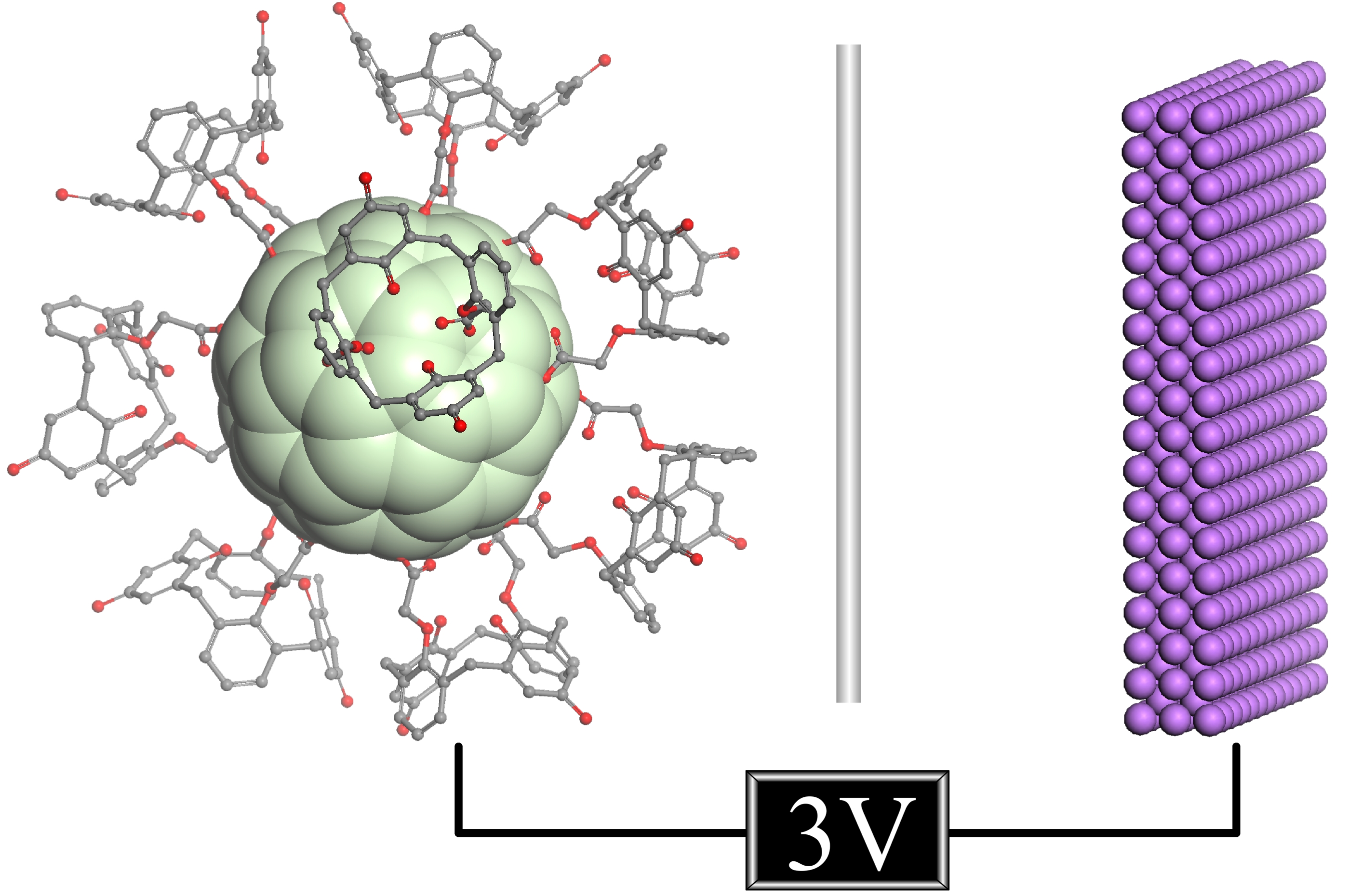
Coworkers of the Laboratory for Materials Electrochemistry, together with colleagues from Faculty of Chemistry and Chemical Technology, University of Ljubljana, have discovered a new principle for construction of batteries based on organic molecules as the active substance.
Organic molecules are offering almost unlimited combinations of atomic arrangements and many possibilities for substitutions; this allows for fine tuning of the desired properties and, at least theoretically, a perfect candidate for Li battery material. However, the most critical problem associated with utilization of most organic molecules in batteries is their high solubility in aprotic electrolytes commonly used in Li-ion batteries. In practice this is seen as a rapid capacity fading of organic batteries. In the paper we propose, for the first time, that this problem can be overcome by grafting (anchoring) of soluble electroactive organic molecules onto the surface of an appropriate insoluble substrate. The essence of this approach is a strong attachment of organic molecules to a suitable substrate. This not only makes the organic molecule stable during the electrochemical operation but also allows tuning of its electrochemical properties (e.g. its redox potential). The paper was published in Angewandte Chemie International Edition
http://onlinelibrary.wiley.com/doi/10.1002/anie.201001539/abstract