

NMR Structure of a Triangulenium-Based Probe Bound to a G-Quadruplex
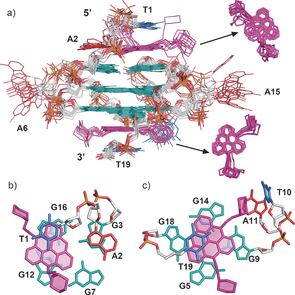
NMR structural study of the interaction between a small-molecule optical probe (DAOTA-M2) and a G-quadruplex from the promoter region of the c-myc oncogene revealed that they interact at 1:2 binding stoichiometry. NMR restrained structural calculations show that binding of DAOTA-M2 occurs mainly through pi–pi stacking between the polyaromatic core of the ligand and guanine residues of the outer G-quartets. High-resolution structure provides molecular guidelines for the design of triangulenium derivatives that can be used as optical probes for G-quadruplexes.
Published in:
Anita Kotar, Baifan Wang, Arun Shivalingam, Jorge Gonzalez-Garcia, Ramon Vilar and Janez Plavec, NMR Structure of a Triangulenium based Long-lived Fluorescence Probe Bound to G-quadruplex, Angew. Chem. Int. Ed. 2016, 55(40), 12508-12511. doi: 10.1002/anie.201606877
Link: http://onlinelibrary.wiley.com/doi/10.1002/anie.201606877/abstract