

Operando impedance spectroscopy for battery research
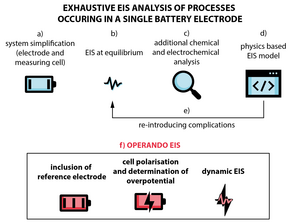
State-of-the-art battery cells are composed of complex heterogeneous electrode structures that pose significant challenges for analyzing electrochemical processes. Traditional electrochemical impedance spectroscopy techniques require system simplification and equilibrium conditions, which limit their ability to capture dynamic processes during battery operation.
This paper introduces an advanced method, which combines operando impedance measurements with real-time monitoring of overvoltage in a three-electrode cell setup. This approach enables detailed analysis of processes occurring under actual operating conditions, overcoming limitations of conventional impedance spectroscopy. The benefits of operando impedance spectroscopy are demonstrated through the study of lithium-metal electrodes during repetitive stripping and plating cycles. The technique allows for the identification and quantification of various electrochemical processes, including those related to lithium diffusion, surface morphology changes, and dendritic growth.
The findings highlight the importance of operando impedance spectroscopy in providing insights that are not accessible through traditional impedance spectroscopy methods, particularly in understanding complex phenomena such as internal short circuits and lithium pitting. The study emphasizes the necessity of combining operando impedance measurements with equilibrium measurements to achieve a comprehensive understanding of battery behavior during operation.
More: https://www.nature.com/articles/s41467-025-57256-0
Contact: sara.drvarictalian@ki.si