

Photocatalytic reduction of CO2 involving excited states
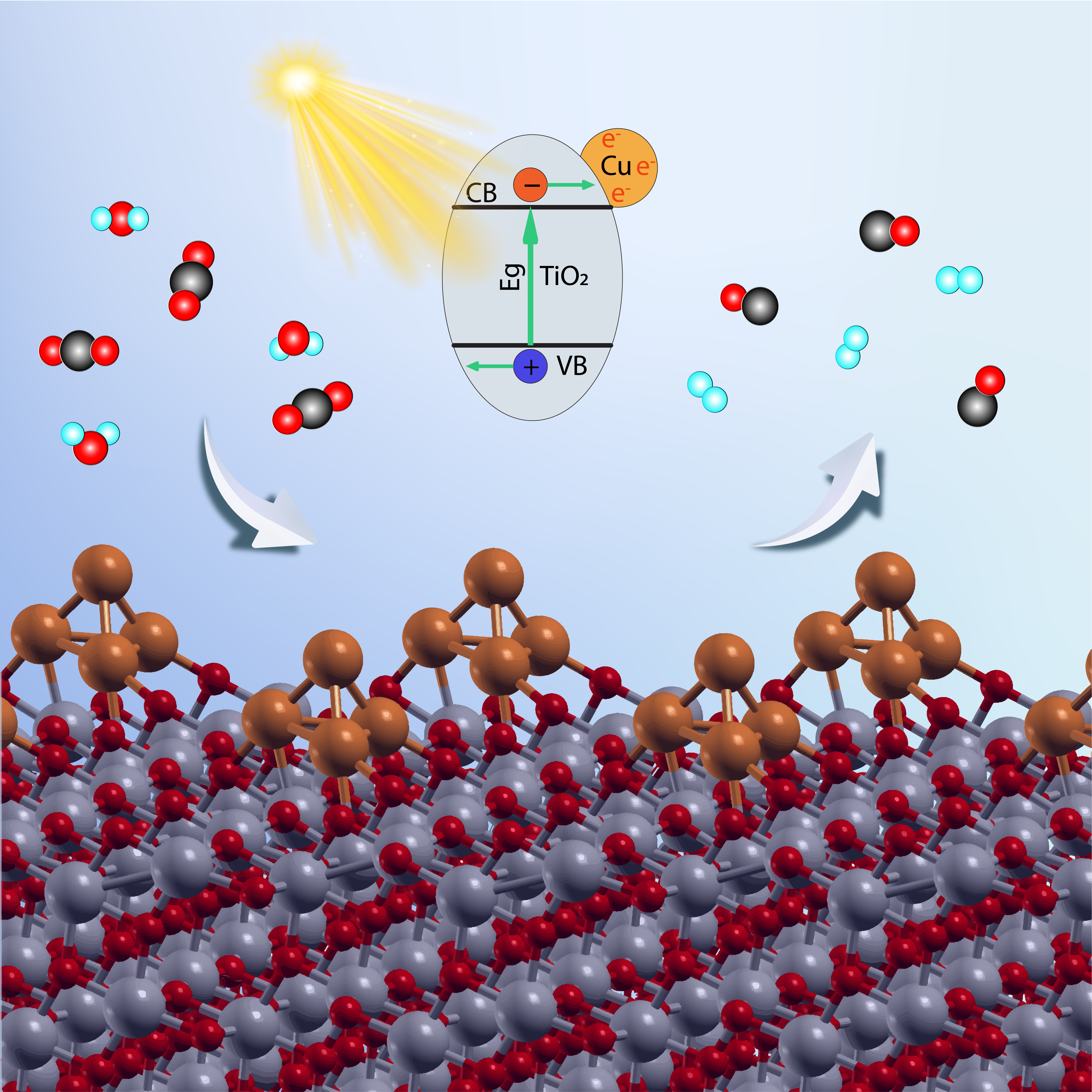
After industrialization and the transition to a carbon-based society, emissions have become a serious environmental issue. One of the most problematic emissions is CO2. For this reason, in recent decades, much attention has been devoted to various methods of capturing and converting CO2 into more valuable chemicals. Among the most promising methods is photocatalysis, which reduces activation barriers with light and thus promotes CO2 reduction. However, most research in the field of photocatalysis is still experimental, with only a few incorporating theoretical calculations, the majority of which due to the complexity of the calculations, do not include excited states.
In our study, we present a theoretical description of the photocatalytic conversion of CO2 into more valuable chemicals using density functional theory (DFT). We established a simple reaction mechanism, which was first calculated in the ground state. Then, we excited an electron from the valence band to the conduction band in the system, thereby increasing the energy and consequently lowering the activation barriers. Microkinetic models showed that in the ground state, the reaction does not proceed, whereas in the system with excited states, we observed the production of CO and H2. This demonstrates the importance of including excited states for an accurate description of photoreduction.
The study conducted by Žan Kovačič, Blaž Likozar, and Matej Huš from the Department of Catalysis and Chemical Reaction Engineering at the National Institute of Chemistry emphasizes the importance of incorporating excited states into the theoretical description of photocatalysis. Due to the complexity and relative underdevelopment of the field, only a few research groups include excited states in their calculations. However, they are of paramount importance for an accurate theoretical description, and the research is applicable to any photocatalytic reaction. The study was published in the Chemical Engineering Journal (IF 15.1).
Link to the article: https://doi.org/10.1016/j.cej.2024.149894