

Similar Photon Utilisation, Different Photocatalytic Performance
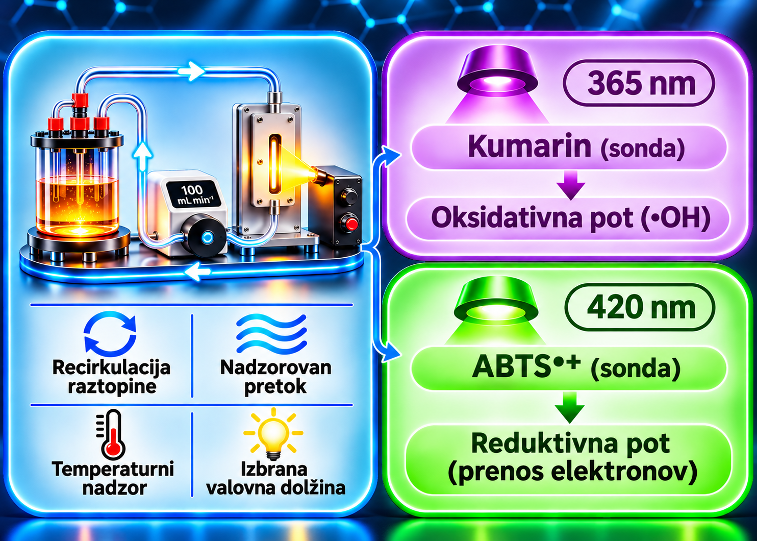
Researchers from the Laboratory for Catalysis at the Department of Inorganic Chemistry and Technology, National Institute of Chemistry, have developed a recirculating-flow photoreactor for the systematic evaluation of immobilized photocatalysts. The study, reported in Applied Surface Science Advances, demonstrates that comparable photon utilisation does not necessarily imply similar photocatalytic performance. Instead, the key lies in how photogenerated charge carriers participate in different oxidative and reductive reaction processes.
Immobilizing photocatalysts on solid supports represents an important step towards practical applications, as it enables material reuse without the need for complex particle separation from treated solutions. However, comparing their performance remains challenging because conventional activity indicators do not always distinguish between different photocatalytic processes. To address this limitation, the researchers developed a flow-based system with controlled flow rate, temperature, and irradiation wavelength, enabling different materials to be evaluated under reproducible experimental conditions.
The study investigated photocatalytic coatings based on titanium dioxide (TiO2), gold-modified TiO2, graphitic carbon nitride (g-C3N4), and g-C3N4/TiO2 composites. Two complementary reaction probes were employed to investigate distinct photocatalytic pathways: coumarin to detect hydroxyl radical (•OH) formation and ABTS•+ to assess reductive electron-transfer activity. To compare the oxidative responses of different materials, the researchers also introduced a photon utilisation index (PUI), which relates probe-product formation to the incident photon flux.
The results demonstrated that TiO2 exhibited the strongest hydroxyl-radical-associated oxidative response under 365 nm irradiation, whereas Au/TiO2 showed the highest ABTS•+ reduction activity at 420 nm. Although their PUI values differed by only approximately 9% at 365 nm, their photocatalytic behaviour under visible-light irradiation was markedly different. During bisphenol A (BPA) degradation under 420 nm irradiation, Au/TiO2 achieved 48% removal after 360 minutes, compared with only 13% for TiO2. These findings further demonstrate that an individual probe reaction cannot reliably predict photocatalytic pollutant removal performance.
The developed platform also enabled the operational stability of immobilized photocatalysts to be assessed over repeated reaction cycles. The findings demonstrate that a comprehensive evaluation of photocatalytic materials requires consideration of reaction pathway selectivity alongside photon utilisation.
The study therefore provides an important methodological foundation for developing and comparing photocatalytic coatings and flow-based systems for environmental applications.
Article: Žerjav, G.; Ali, S.; Pintar, A. A mechanistic recirculating-flow photoreactor platform for benchmarking immobilized photocatalysts. Applied Surface Science Advances, 2026, 36, 101111. doi.org/10.1016/j.apsadv.2026.101111
Contact: Albin Pintar (albin.pintar@ki.si); Gregor Žerjav (gregor.zerjav@ki.si)