Positive Effect of Surface Doping with Au on the Stability of Pt-Based Electrocatalysts
The article is a result of collaboration between Laboratory for Materials Chemistry, Laboratory for Analytical Chemistry and German institute Max Planck from Düsseldorf. The most important message of the article is ''less can be more'', as just a small addition of gold in first few surface layers of PtCu3 alloy nanoparticles substantially is shown to improve the stability of the PtCu3/C composite.
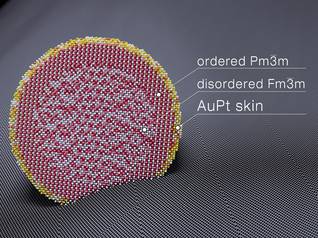
The composite is used as an electrocatalyst for oxygen reduction reaction on the cathode of polymer electrolyte membrane fuel cell (PEMFC) where strong perchloric acid is used as an electrolyte. Researchers doped the surface of the ordered PtCu3 alloy with gold in a controlled manner, which was directly confirmed with the help of transmission electron microscopy. The gold doped catalyst (containing the so-called PtAu skin) was then systematically compared to its starting version of catalyst (PtCu3/C). The only difference between the materials was the approximately 1 %atomic of gold. During its operation the gold doped material exhibited substantially less copper dissolution, which was directly confirmed with an advanced analytical method EFC-ICP-MS. Additionally, the gold doped material also exhibited less CO2 oxidation of the high surface area carbon support, as confirmed with another advanced analytical method - SFC-OLEMS. The improvement in carbon support stability was additionally confirmed using elevated temperature TF-RDE measurements (60 oC), in which real fuel cell environment was simulated.