

RTIT>> action planning work group assembled
In April, a dedicated RTIT>> work group has been formed, which will hold a series of meetings to develop an action plan, transnational roll-out plans and individual demonstration plans for piloting countries. While the group is primarily composed of consortium members, some partners have appointed external experts to contribute to the process. At the National Institute of Chemistry, we have involved the Ljubljana University Incubator (LUI) to help us plan the activities to be implemented at the national level and transnational levels.
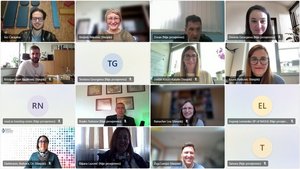
Introductory meeting of the RTIT>> action planning work group.
Our action planning work group is primarily composed of university professors and academic researchers with deep expertise in material technologies and innovation transfer. Their engagement is instrumental in forming and activating know-how communities, which are a cornerstone of the RTIT>> project. The efforts of the group are guided by the New Industrial Strategy for Europe, the European Industrial Innovation Policy as well as other related EU strategies, bringing the focus on advanced materials, bio-based materials as well as sustainable materials and technologies.
The action planning work group will focus on several key phases:
1. Mapping know-how communities
The first phase involves identifying and forming so-called know-how communities – networks of stakeholders essential for innovation transfer. The working group will design a framework for thematic group roll-out plans, which will serve as a basis for developing individual tailored demonstration plans for national pilot actions.
The initial efforts will be focused on mapping relevant actors, such as public research organizations and universities, SMEs, start-ups and policymakers at the national level. The meetings of the work group will help identify the key challenges for piloting activities in order to foster strong cooperation with innovation-driven businesses, while also promoting interest in transnational cooperation.
2. Launching a call for SMEs and start-ups
As the groundwork for individual demonstration plans is laid, a targeted call will be launched to engage SMEs and start-ups interested in the identified topics. Participants will be encouraged to apply design thinking tools to explore joint cooperation opportunities.
3. Piloting with 1:1 engagement
The first pilot phase will introduce direct 1:1 collaboration between businesses and know-how communities in the Danube Region, which will be facilitated by either internal or external experts.
4. Transnational expansion of know-how communities
While starting at the national-level activities, these know-how community are set to expand at the transnational level. The topics of the thematic groups will be broadened and further tapped into using tailored collaboration tools, thereby strengthening the project's reach and impact across the Danube Region.
5. Review and reflection
In the final stage, the know-how communities and thematic groups will review the outcomes of pilot actions and reflect on the effectiveness of the applied tools and methodologies. This process will provide a crucial input for finalizing the RTIT>> action plan.
These upcoming collaborative efforts will play a key role in developing a strategic and binding action plan aligned with regional needs, strengthen innovation capacity and enable SMEs to tap into transnational research and business opportunities. Once finalized and endorsed through a Memorandum of Understanding (MoU), the action plan will serve as a foundational document guiding long-term innovation transfer and cooperation in the Danube Region.