

Size matters: Effect of the size of active sites on the catalyst activity for CO2 reduction
Ljubljana, 10.03.2020 - Catalysts are a necessity in the modern world as they enable us to carry out industrially important chemical reactions. They are not consumed during the reaction, but without their presence many reactions do not take place. Finding an optimal catalyst is a tough problem because, in addition to the chemical composition, the size and shape of particles also play an important role. Most of catalysts contain many different elements or active phases. In this research, the researchers have theoretically explained why catalysts with more active phases perform better than the sum of the activities of individual active phases would imply. They have also explained why the shape and size of active phases are crucial for the activity. These results will allow for a targeted computer-based search and synthesis of better catalysts in the future.
Researchers from the Department of Catalysis and Chemical Reaction Engineering (D13) have theoretically explained the experimental findings that catalyst activity strongly depends on the size of active sites and on the synergistic effect of different metals in catalysts.
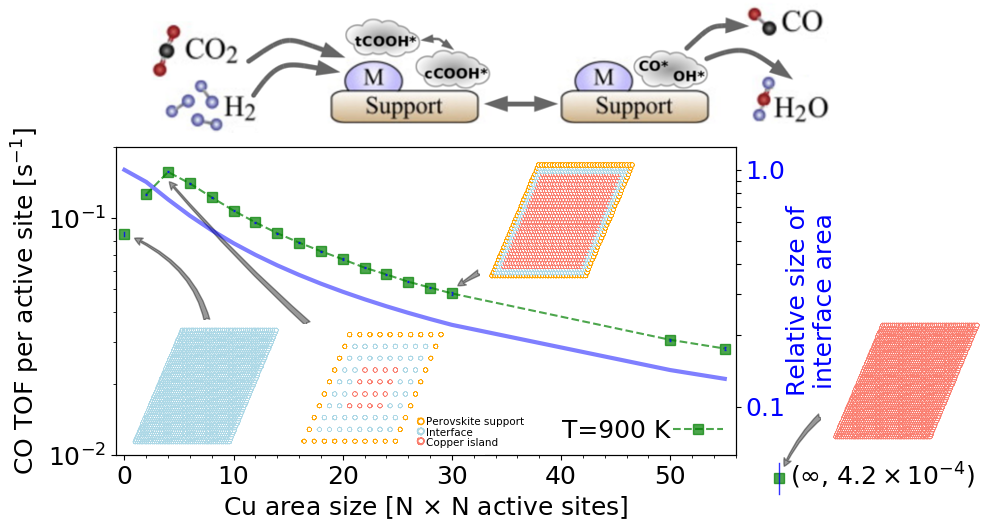
In their study, they studied the effect of the size of the active area on the activity of perovskite-supported bifunctional catalysts for CO2 activation with the reverse water-gas shift (RWGS) reaction. Drejc Kopač, Blaž Likozar and Matej Huš have used multiscale modelling on the atomic (DFT) and meso (kMC) scale to simulate the mechanism of RWGS on three surfaces: on pure copper (active sites), on strontium titanate in perovskite structure (support) and on their contact (interface). Using kinetic simulations they showed that the reaction proceeds fastest at the interface. The inclusion of other phases further accelerates the reaction, proving that the advantages of bifunctional catalysts surpass a mere formation of the interface and include an active interplay of all the three phases. On copper, hydrogen adsorption takes place; on the interface, CO2 is activated and reduced, while the products desorb from the support.
Additional simulations revealed that the rate of the reaction depends on the size of the cooper active area. As the active area grows in size, the activity is reduced because the relative fraction of the interphase decreases. This proves that ensuring the stability of the active phase and the prevention of sintering plays a key role in catalyst design.
The theoretical study confirms and explains a well known experimental fact that the size and shape of the catalyst surface influences its activity. The results are published in ACS Catalysis (IF=12.21).
KOPAČ Drejc, LIKOZAR, Blaž, HUŠ, Matej. How Size Matters: Electronic, Cooperative and Geometric Effect in Perovskite-supported Copper Catalysts for CO2 Reduction", ACS Catalysis, 2020, doi: 10.1021/acscatal.9b05303.
Link to the paper: pubs.acs.org/doi/10.1021/acscatal.9b05303
For further information please contact: matej.hus[at]ki.si