Slovenian scientists invent a new method to incorporate switches and digital memory into mammalian cells

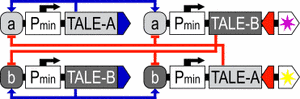
Bistable switches are fundamental elements for information management and storage in electronic devices, such as for example memory sticks. Scientists first incorporated genetic switches into bacterial cells over a decade ago, but the capacity of those switches was limited to a few specific examples. Researchers from the Department of Biotechnology of the National Institute of Chemistry and from the Centre of excellence EN-FIST now succeeded in constructing genetic switches, which can, in principle, be designed in thousands of variations. Multiple switches could simultaneously function in a single cell, meaning that such cells would be easier to control and capable of storing more information. This discovery is potentially interesting for use in medicine and biotechnology, for example for new biosensors or cell therapy.
The research, published in the journal Nature Communications, is an upgrade of the project of the Slovenian iGEM team, which was very successful at the international student research competition in synthetic biology in 2012. Most of the students and advisors contributed to the completion of the project for publication, where they demonstrated how to construct even more complex, multistable genetic switches. The key for this advance was the use of modular proteins, which can be designed in millions of variants. Incorporation of multiple feedback loops was necessary to develop functional switches, which was a demanding task and an important conceptual novelty that earned publication in the distinguished journal. Computational modeling of the biological system, performed by students from the Faculty of Computer and Information Science of the University of Ljubljana played an important role in the discovery.
The researchers concede that biological computers will never be able to compete with electronic computers regarding speed and memory capacity, however, they will certainly find place as interfaces for controlling biological systems.
The authors of the paper entitled »A bistable genetic switch based on designable DNA-binding domains« are: Tina Lebar, Urban Bezeljak, Anja Golob, Miha Jerala, Lucija Kadunc, Boštjan Pirš, Martin Stražar, Dušan Vučko, Uroš Zupančič, Mojca Benčina, Vida Forstnerič, Rok Gaber, Jan Lonzarić, Andreja Majerle, Alja Oblak, Anže Smole and Roman Jerala.
The paper is available at:
http://www.nature.com/ncomms/2014/140929/ncomms6007/full/ncomms6007.html