

Stability of catalysts for electrochemical CO2 reduction
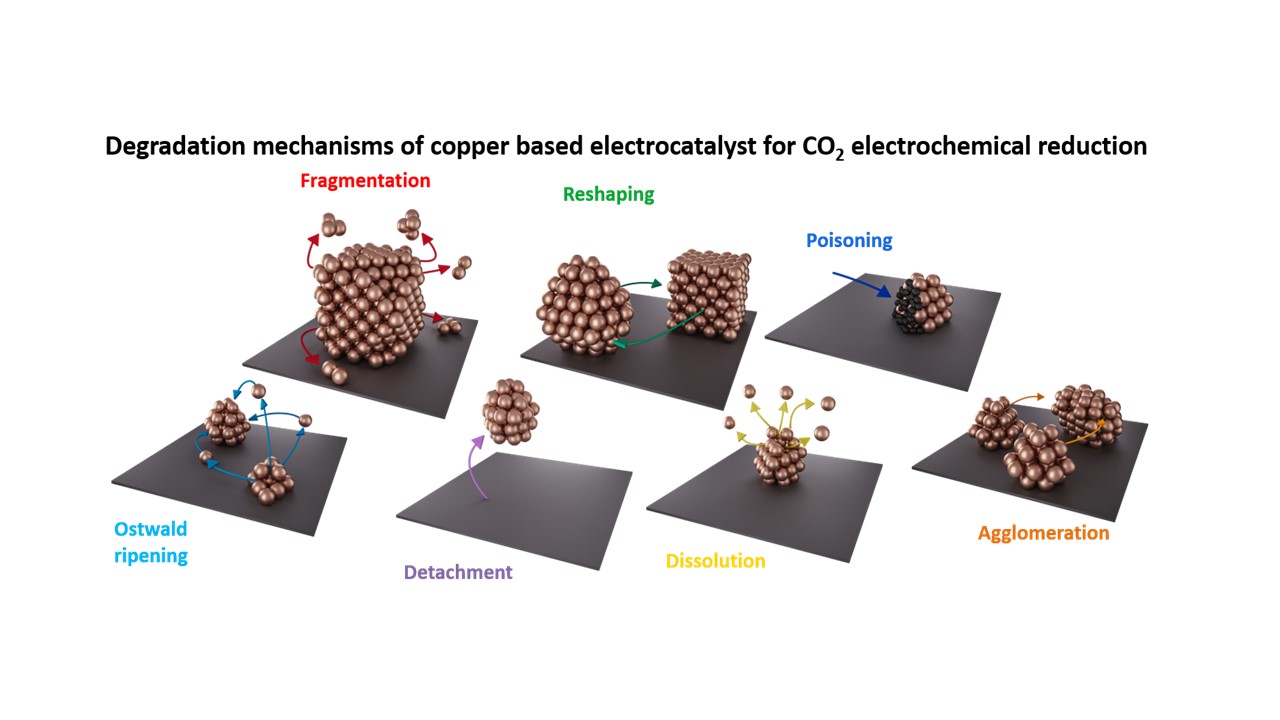
Ljubljana, April 8, 2020 - In recent years, the electrochemical CO2 reaction reduction to chemical fuels and other energy-dense products, powered by renewable energy, has become one of the most intriguing challenges in the field of electrocatalysis. Great efforts have been directed towards understanding how copper catalysts structure affects activity and selectivity for this reaction. Nevertheless, to advance towards applied systems, the stability of the catalysts during electrolysis is of great significance.
Researchers from the Laboratory for Electrocatalysis from the Department of Materials Chemistry (D10) in close collaboration with researchers from École Polytechnique Fédérale de Lausanne (EPFL) under the guidance of Assoc. Prof. Dr. Nejc Hodnik and Prof. Dr. Raffaella Buonsanti have summarized the recent progress on understanding the stability of copper‐based catalysts, along with the proposed degradation mechanisms.
Mini-review entitled 'Stability and degradation mechanisms of copper-based catalysts for electrochemical CO2 reduction' is published in the journal Angewandte Chemie (IF = 12.257).
Link: onlinelibrary.wiley.com/doi/epdf/10.1002/anie.202000617
For further information please contact: nejc.hodnik[at]ki.si