

Structure of a Stable G Hairpin
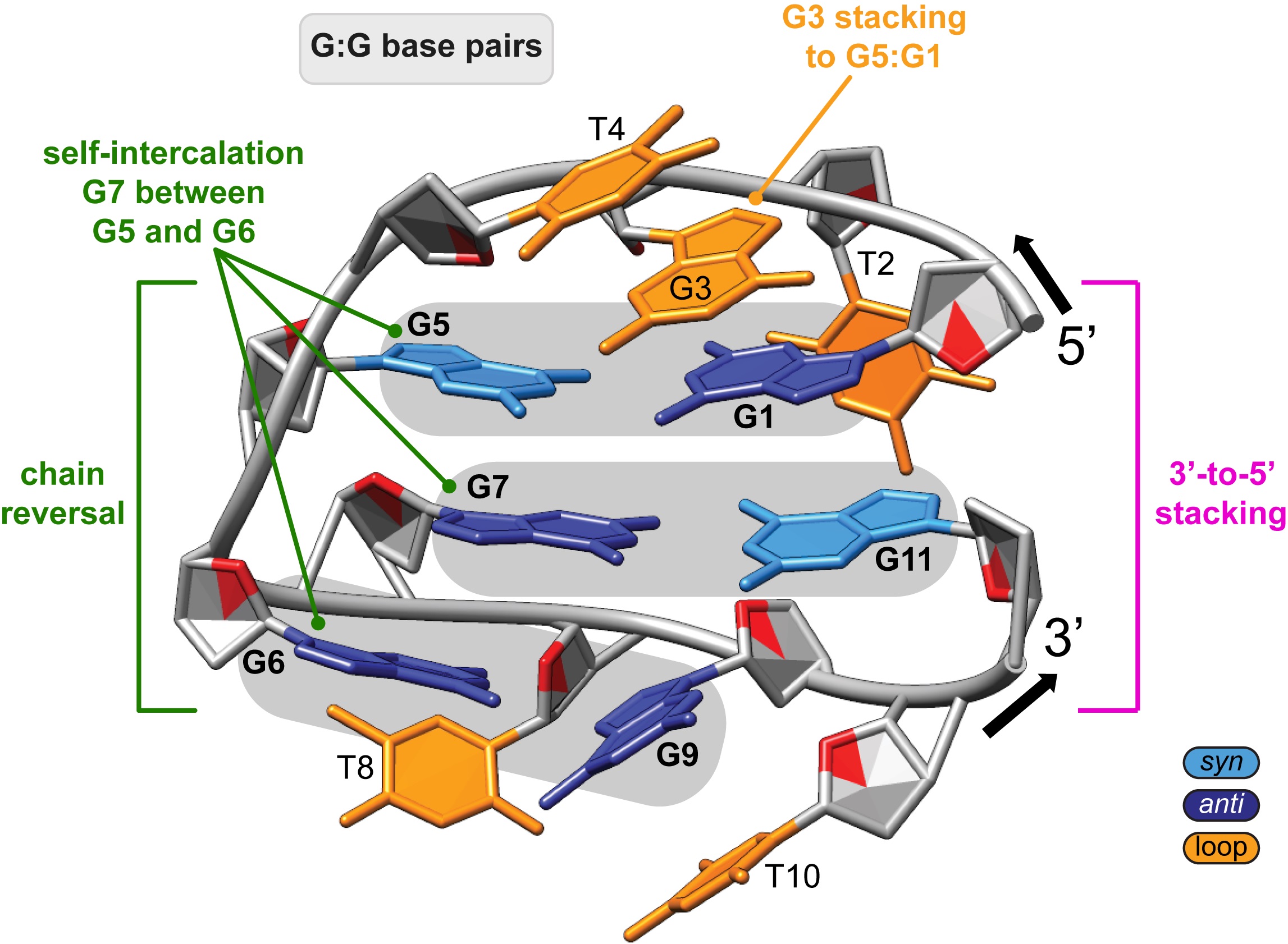
An 11-nt long G-rich DNA oligonucleotide, 5′-d(GTGTGGGTGTG)-3′, corresponding to the most abundant sequence motif in irregular telomeric DNA from Saccharomyces cerevisiae (yeast) has been shown to fold into a G-hairpin. The first atomic resolution structure of a stable G-hairpin formed by a natively occurring DNA sequence demonstrates a novel type of mixed parallel/antiparallel fold-back DNA structure, which is stabilized by dynamic G:G base pairs that transit between N1-carbonyl symmetric and N1-carbonyl, N7-amino base-pair arrangements. G-hairpin is thermodynamically stable structure with a rather complex topology that includes a chain reversal arrangement of the backbone in the center of the continuous G-tract and 3′-to-5′ stacking of the terminal residues. The structure reveals previously unknown principles of the folding of G-rich oligonucleotides that could be applied to the prediction of natural and/or the design of artificial recognition DNA elements. The structure also demonstrates that the folding landscapes of short DNA single strands is much more complex than previously assumed.
Results were published in J. Am. Chem. Soc. (Martin Gajarský, Martina Lenarčič Živković, Petr Stadlbauer, Bruno Pagano, Radovan Fiala, Jussara Amato, L’ubomír Tomáška, Jiří Šponer, Janez Plavec and Lukáš Trantírek, Structure of a Stable G‑Hairpin, J. Am. Chem. Soc. 2017, 139 (10), 3591-3594. doi: 10.1021/jacs.6b10786, COBISS ID 6101274). tt
Link to publication: http://pubs.acs.org/doi/abs/10.1021/jacs.6b10786
Described paper has been highlited in JACS Spotlights, http://pubs.acs.org/doi/abs/10.1021/jacs.7b02760
<iframe frameborder="0" height="315" width="560" src="https://www.youtube.com/embed/VQU5VFBXRIE"></iframe>