

The Achilles' heel of iron-based catalysts during oxygen reduction in an acidic medium
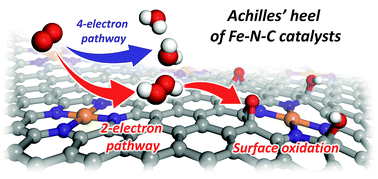
Proton-exchange membrane fuel cells (PEMFCs) have reached technological maturity, highlighted by their rapidly growing transportation and stationary markets. In the long term, however, the current use of significant amounts of precious metals to catalyse, in particular, the oxygen reduction reaction (ORR) at the cathode could limit their sustainable deployment. Alternatively, inexpensive iron–nitrogen–carbon (Fe–N–C) catalysts have recently shown tremendous progress in their initial activity for the ORR, and high stability upon electrochemical cycling in acidic electrolytes, but surprisingly low durability in operating PEMFCs. A better understanding of their degradation mechanisms during operation is thus key to the identification of strategies for improved durability.
In the work, we show that FeNxCy moieties in a representative Fe–N–C catalyst are structurally stable but electrochemically unstable when exposed in an acidic medium to H2O2, the main ORR by-product. Exposure to H2O2 leaves iron-based catalytic sites untouched but decreases their turnover frequency via oxidation of the carbon surface. The latter is triggered by reactive oxygen species generated during decomposition of H2O2 on such sites. Observed in acidic but not in alkaline electrolytes, these insights suggest that durable Fe–N–C catalysts are within reach for PEMFCs if rational strategies minimizing the amount of H2O2 or reactive oxygen species produced during the ORR are developed.
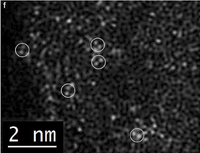
ARSTEM micrograph of Fe atom pairs in carbon support
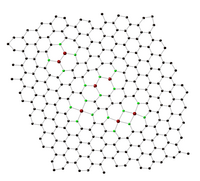
Models of FexNyC moieties
Authors of the work are coming from different institutions from Korea, Germany, France and National Institute of Chemistry (Goran Dražić, department D10). The work was published in Energy & Environmental Science.
Original paper at: https://pubs.rsc.org/en/content/articlelanding/2018/ee/c8ee01855c