

The discovery of the new promising antibiotic lead

A research team working in the scope of international consortium comprised of Biotechnical faculty from University of Ljubljana, SME Acies Bio d.o.o. (Ljubljana), National Institute of Chemistry (Ljubljana), Helmholtz institute, HIPS (Helmholtz-Institute for Pharmaceutical Research Saarland, Germany), Univesity of Strathclyde (Scotland) and Hospital Universario Marques de Valdecilla (Spain) has succeeded to construct a novel antibiotic carboxyamido-chelocardin belonging to a group of atypical tetracyclines produced by bacteria Amycolatopsis suplhurea.
A broad-spectrum antibiotic lead was generated with significantly improved activity, including against all Gram-negative pathogens of the ESKAPE panel. Since the lead structure is also amenable to further chemical modification, it is a platform for further development through medicinal chemistry and genetic engineering.
The research was published in well-recognized journal Angewandte chemie (Lešnik et al., Angew Chem Int Ed Engl. doi: 10.1002/anie.201411028). The colleagues from the Analytical Chemistry Laboratory (L-04) at the National institute of chemistry have contributed to the work with structure elucidation of the newly synthesized compounds with mass spectrometry.
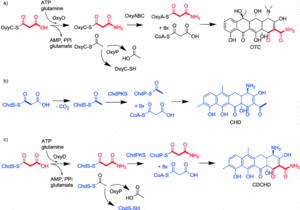
Priming steps in OTC biosynthesis (a)13 and CHD biosynthesis (b),15 and proposed malonamate priming in CDCHD biosythesis (c). The starter unit in OTC biosynthesis is indicated in red, the CHD structure in blue, and OTC in black.