

Third metal complements two-metal-ion motif in RNA catalysis
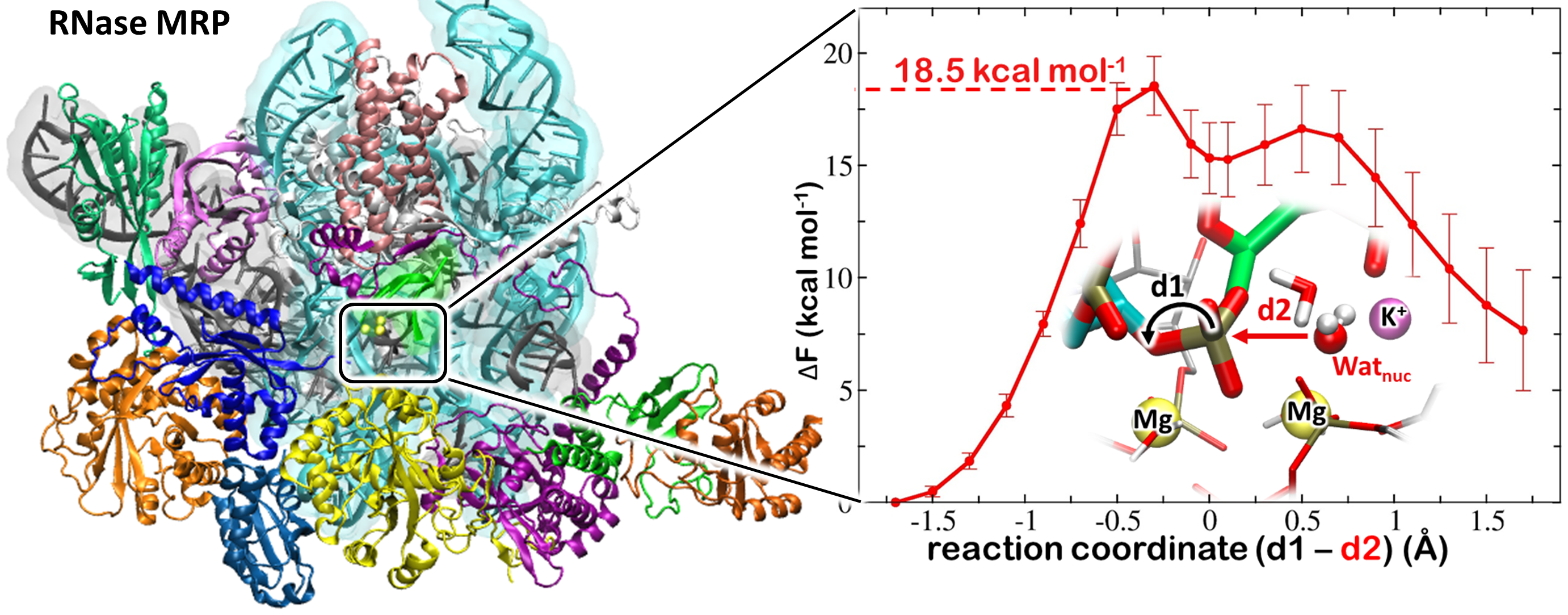
Nucleic acid processing enzymes use a two-Mg2+-ion motif to promote the formation and cleavage of phosphodiester bonds. Yet, recent evidence demonstrates the presence of spatially conserved second-shell cations surrounding the catalytic architecture of proteinaceous and RNA-dependent enzymes. The RNase mitochondrial RNA processing (MRP) complex, which cleaves the ribosomal RNA (rRNA) precursor at the A3 cleavage site to yield mature 5'-end of 5.8S rRNA, hosts in the catalytic core one atypically-located Mg2+ ion, in addition to the ions forming the canonical catalytic motif.
By employing biased quantum classical molecular dynamics simulations, discover that the third Mg2+ ion inhibits the catalytic process. Instead, its displacement in favor of a second-shell monovalent K+ ion propels phosphodiester bond cleavage by enabling the formation of a specific hydrogen bonding network that mediates the essential proton transfer step. Our results further broaden our understanding of the role of second shell metal ions in expanding and complementing the canonical two-Mg2+-ion catalytic motif and demonstrate that the precise identification of divalent and monovalent metal ions is critical for untangling function, and regulation of nucleic acid processing enzymes/ribozymes.
Our simulations of the cleavage reaction in presence of different metal cofactors provide evidence that metal ions can play an agonistic or antagonistic role depending on their position and on their nature. Our findings support the idea that cation trafficking is a general feature of DNA and RNA processing enzymes.
This article was published in Angewandte Chemie (IF = 16.1), the authors of the research are dr. Jure Borišek from National Institute of Chemistry (D01, Laboratory for Cheminformatics), dr. Jana Aupič (CNR-IOM, Italy) and prof. dr. Alessandra Magistrato (CNR-IOM, Italy).
More information: https://onlinelibrary.wiley.com/doi/10.1002/anie.202405819
Contact: jure.borisek@ki.si